policy
Why is it so difficult to convert an Air Force aircraft to a naval carrier-borne aircraft?
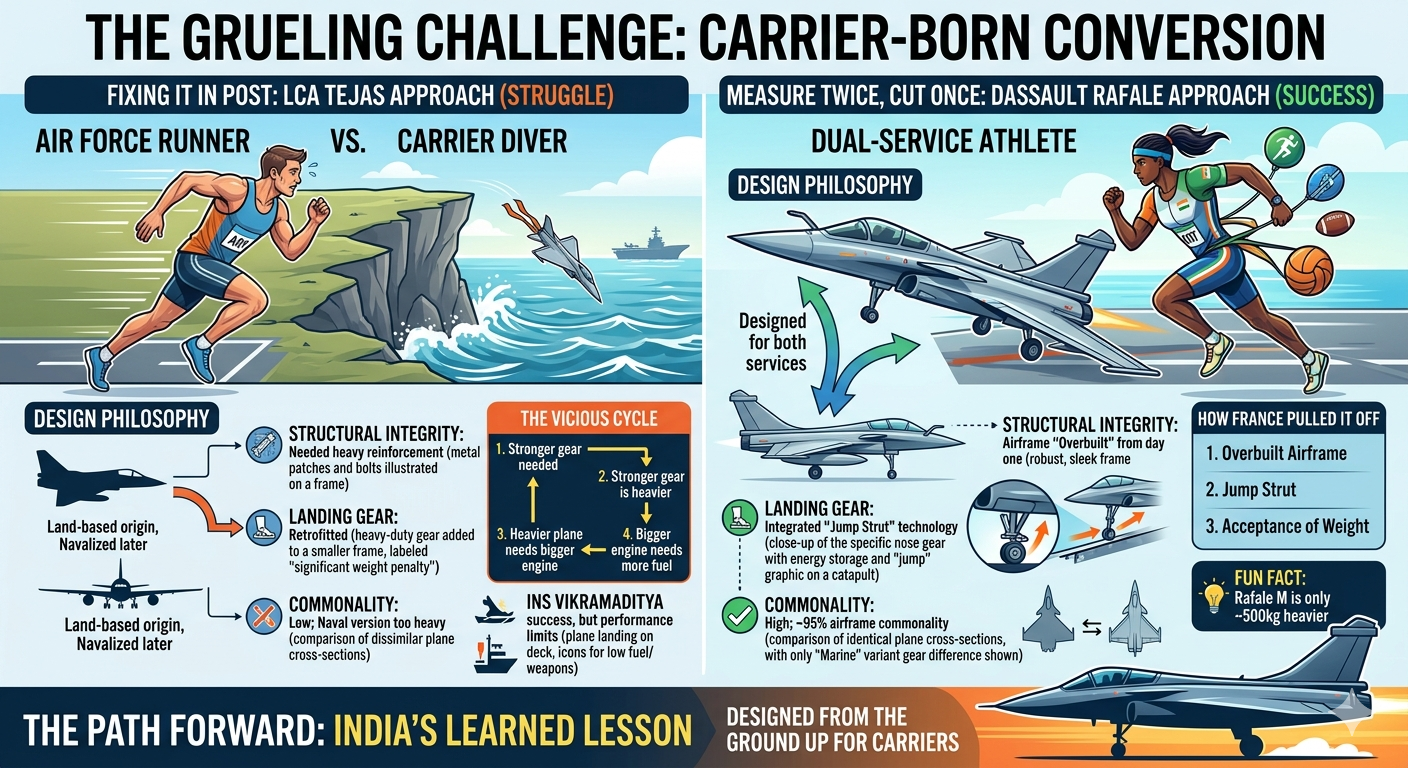
It is a classic “measure twice, cut once” versus “fixing it in post” scenario. One of the most grueling challenges in aerospace engineering is the carrier-born conversion.
The French also didn’t really “get around” the problem—they avoided it by designing the Rafale as a naval aircraft from the very first sketch.
The Core Difference: Design Philosophy
The struggle with the LCA Tejas (and many other aircraft like the naval F-111 or the F-22) is that they were designed for the Air Force first. Converting a land-based plane to a carrier-based one is like trying to turn a marathon runner into a champion cliff diver.
| Feature | LCA Tejas Approach | Dassault Rafale Approach |
|---|---|---|
| Origin | Designed for land; “Navalized” later. | Designed for both services simultaneously. |
| Structural Integrity | Needed heavy reinforcement after the fact. | Airframe was “overbuilt” from day one. |
| Landing Gear | Retrofitted (added significant weight). | Integrated “Jump Strut” technology. |
| Commonality | Low; Naval version became too heavy. | ~95% airframe commonality. |
How France Pulled it Off
France’s success with the Rafale M (Marine) boils down to three strategic moves:
1. The “Overbuilt” Airframe
Dassault knew the French Navy (Marine Nationale) needed a carrier-capable jet. Instead of making two different frames, they built one incredibly tough airframe for everyone. While this made the Air Force version (Rafale C) slightly heavier than it strictly needed to be, it meant the naval version didn’t need a massive, weight-gaining structural overhaul.
2. The “Jump Strut” Nose Gear
One of the hardest parts of carrier ops is the catapult launch. The Rafale M uses a unique “jump strut” nose gear. It stores energy as the plane is hooked to the catapult and releases it at the end of the deck, literally “jumping” the nose up to give the plane the necessary angle of attack for flight. Because this was planned early, the weight penalty was minimized.
3. Acceptance of Weight
The French Air Force accepted a slight performance trade-off to ensure the Navy got what it needed. In contrast, the LCA Tejas was designed to be “Light” (it’s in the name). When you add the heavy-duty landing gear, arrestor hooks, and wing-folding mechanisms required for a carrier, the “Light” fighter suddenly becomes “Medium” weight, but without the extra engine thrust to compensate.
Why the LCA Tejas Struggled
The naval LCA Tejas Mk1 actually successfully landed and took off from the INS Vikramaditya, which was a massive achievement for India. However, the Navy ultimately realized that by the time they added all the “naval” bits to an Air Force design, the plane had very little room left for fuel and weapons.
The weight of the landing gear alone was a dealbreaker. It’s a vicious cycle:
- You need stronger gear to survive a “controlled crash” onto a deck.
- Stronger gear is heavier.
- A heavier plane needs a stronger wing to hold that gear.
- Now the plane is so heavy you need a bigger engine.
- A bigger engine needs more fuel… and so on.
Fun Fact: The Rafale M is only about 500 kg (1,100 lbs) heavier than the land-based version. For most aircraft, that conversion penalty is usually much, much higher.
The Path Forward
India has learned from this. Instead of forcing the Tejas to do something it wasn’t born for, they are now developing the TEDBF (Twin Engine Deck Based Fighter). Like the Rafale, this is being designed from the ground up specifically for the carrier deck.
India has learnt crucial lessons that will help indigenous naval aviation. Commendably, in the interim the Indian Air Force and the Navy have gone for the Rafale.