policy
India & the Pax Silica Consortium: Transitioning from Tech Dependency to Interdependent Sovereignty
Soumya Banerjee
This policy brief outlines the strategic framework of India’s entry into the Pax Silica Consortium (formally the Pax Silica Declaration), signed on February 20, 2026, during the India AI Impact Summit in New Delhi.
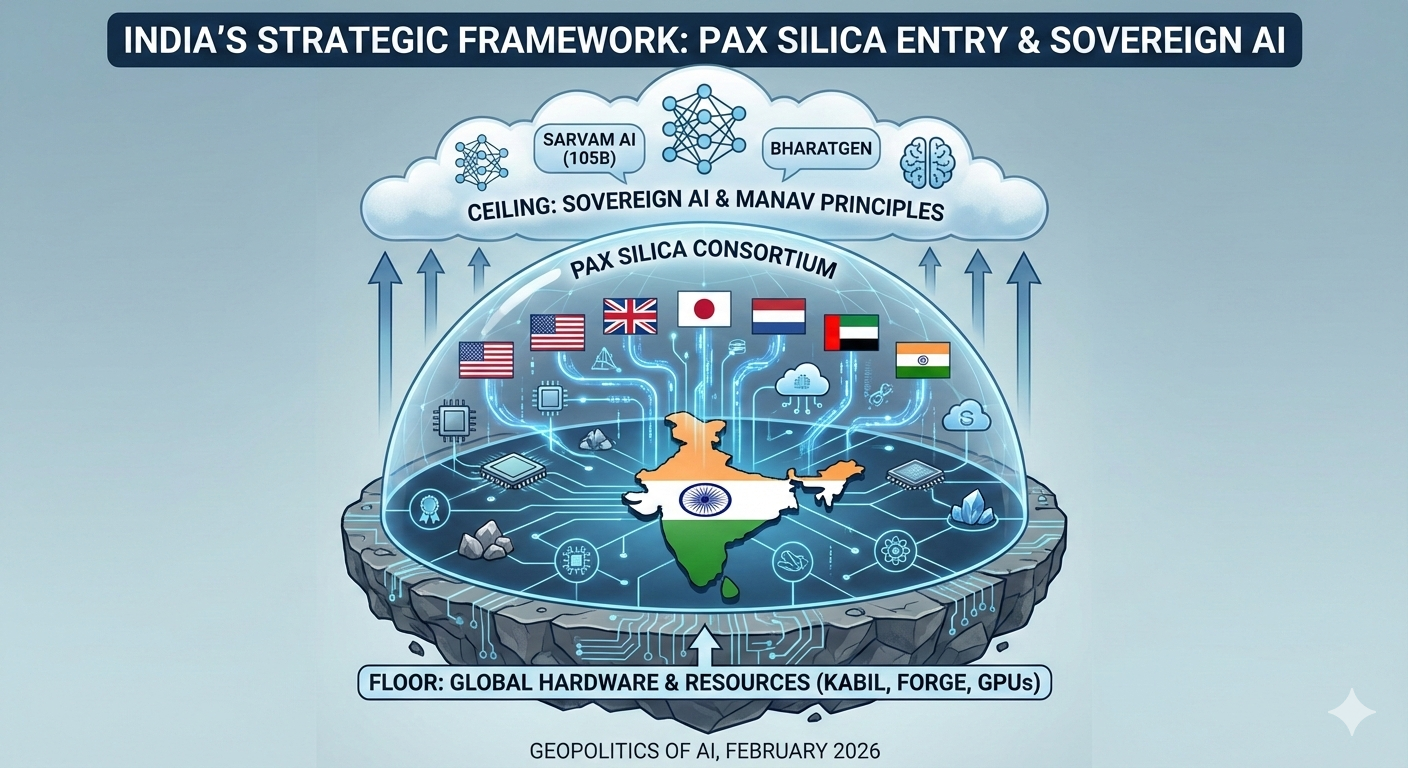
- Short Policy: The “Silicon-First” Strategy Objective: To secure India’s technological future by integrating with the global “trusted” supply chain while accelerating domestic AI self-reliance.
- Pillar I: Resource Security: Partner with Pax Silica nations to acquire and process critical minerals (Gallium, Germanium, Lithium) via KABIL and FORGE initiatives to reduce reliance on non-aligned states.
- Pillar II: Compute Sovereignty: Leverage the IndiaAI Mission to deploy 34,000+ GPU clusters, utilizing Pax Silica partnerships for priority access to advanced nodes (2 nanometre and below).
- Pillar III: Open-Society AI: Ensure AI development follows “Moral, Ethical, Accountable, National, Accessible, and Valid” (MANAV) principles, aligning with the Consortium’s “Trusted Ecosystem” standards.
Context
In late 2025, the U.S. launched Pax Silica, a strategic alliance (including the UK, Japan, UAE, and the Netherlands) designed to secure the “full silicon stack.” India joined in February 2026 as the 12th signatory, marking a shift from non-alignment to “strategic alignment” in the AI era.
Key Issues
- Weaponized Dependency: Global AI power is currently concentrated in two poles: the US (software/capital) and China (minerals/refining). India’s 95% import dependency on semiconductors creates a “sovereignty deficit.”
- The Compute Chokepoint: Access to high-end H100/B200-class GPUs is the “new oil.” Without membership in Pax Silica, India faces potential export controls or “priority queues” that could stall domestic innovation.
Strategic Recommendations
- Fabrication Integration: Fast-track the Tata-PSMC and Micron Sanand projects as “Pax Silica Certified” facilities to ensure seamless integration into the global high-tech value chain.
-
Data-Compute Swap: Offer the “Indian Data Scale” (1.4 billion users) as a collaborative sandbox for Pax Silica partners in exchange for technology transfer in Lithography (ASML) and chip-design software.
- Policy Paper: The Geopolitics of AI and Indian Sovereignty
I. The New Geopolitical Calculus: “Pax Silica” vs. The Digital Wall
The 21st-century order is no longer defined by territorial borders but by Compute Borders. The Pax Silica Consortium represents a “technological iron curtain” designed to decouple “trusted” democracies from surveillance-driven AI models. For India, joining is not just an economic move; it is an act of defensive realism. By aligning with the Netherlands (Lithography), Japan (Chemicals), and the US (Design), India secures the physical foundation—the Silica—required for peace—the Pax.
II. Impact on Sovereign AI: The “Floor and Ceiling” Model
There is a perceived tension between joining a Western-led consortium and maintaining “Sovereign AI.” However, India’s policy treats these as complementary:
- The Floor (Hardware): Pax Silica provides the hardware floor. By securing chips and minerals through the consortium, India ensures that its “Sovereign AI” isn’t built on shifting sands.
- The Ceiling (Software/Models): Sovereignty is exercised at the model level. India’s launch of Sarvam AI (105B) and BharatGen proves that while the chips may be global, the intelligence is local. These models are trained on Indic data and governed by Indian law, fulfilling the MANAV vision.
III. Conclusion: Leading the Global South
By joining Pax Silica, India avoids being a “digital colony.” It leverages the consortium to build its own industrial capacity, eventually aiming to become the “third pole” of AI—one that combines Western hardware reliability with the inclusive, scalable AI diffusion models needed for the Global South.