policy
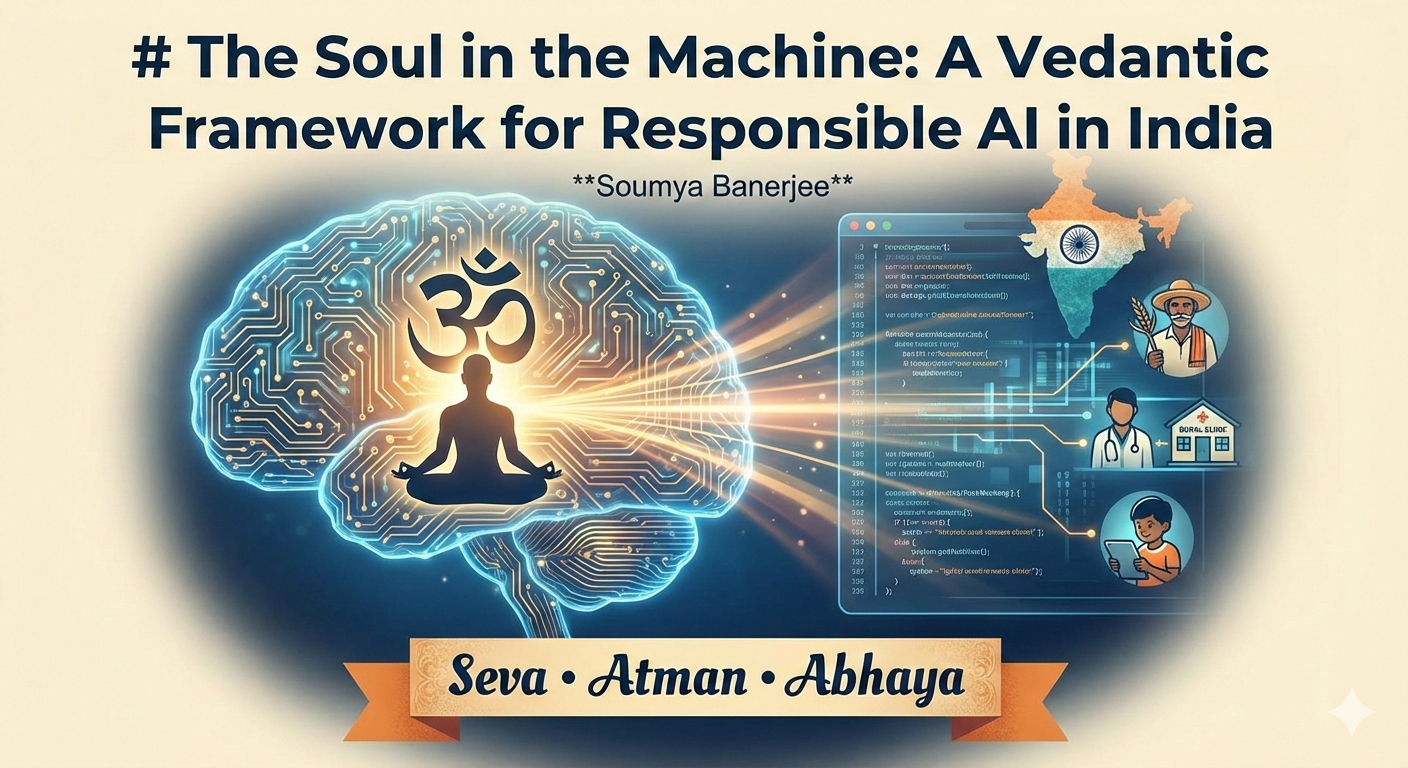
The Soul in the Machine: A Vedantic Framework for Responsible AI in India
Soumya Banerjee
Abstract
As India emerges as a global epicenter for Artificial Intelligence, the vacuum between rapid technological acceleration and ethical governance grows. This manuscript proposes a uniquely Indian framework for Responsible AI, anchored in the “Practical Vedanta” of Swami Vivekananda. Rather than viewing technology through a lens of mere compliance, this work synthesizes core Vedantic tenets, specifically Seva (service to the marginalized), Atman (the preservation of human agency), and Universalism (the mitigation of algorithmic bias), to advocate for a “conscience-driven” approach to innovation. The manuscript argues that India’s AI roadmap must move beyond profit-maximization to focus on “Man-making” education and the upliftment of the Daridra Narayana (the underserved). By integrating these timeless spiritual principles with modern data science, India can offer the world a “Third Way” of AI governance: one that balances fearless innovation with an unwavering commitment to human dignity and social harmony.
I. Introduction: The Need for a Philosophical Anchor
As India emerges as a global hub for AI development, the conversation often centers on compute power, data sets, and regulatory sandboxes. However, for technology to truly serve a nation as diverse and spiritually rooted as India, it requires a moral “North Star.” Swami Vivekananda’s philosophy (centered on the divinity of the individual and the mandate of selfless service) provides a profound framework for Responsible AI. It moves the conversation from mere “compliance” to “conscience.”¹
II. The Core Pillars of Vivekananda-Inspired AI
1. Seva (Service): AI for the “Daridra Narayana”
Vivekananda’s primary teaching was that service to humanity is service to God. In the context of AI, this shifts the focus from profit-maximization to social impact.
- The Principle: AI should not merely optimize ad-clicks; it should address the “wicked problems” of the marginalized.
- Application: Prioritizing AI in vernacular language translation for farmers, early diagnostic tools for rural health clinics, and personalized education for first-generation learners.
2. Atman (Self-Knowledge) and Human Agency
Vivekananda emphasized that “all power is within you.” A responsible AI approach must ensure that technology augments rather than diminishes human agency.
- The Principle: AI should be a tool for self-realization, not a crutch that leads to intellectual atrophy.
- Application: Designing AI systems that are transparent and explainable, ensuring that the “human-in-the-loop” retains the moral and cognitive authority to make final decisions.
3. Abhaya (Fearlessness) and Innovation
He often said, “The transition from sorrow to joy is through fearlessness.” Responsible AI in India should not be born out of a fear of technology, but out of the courage to build it safely.
- The Principle: We should not stifle innovation through over-regulation, but we must have the courage to halt systems that threaten social harmony.