science_blog_fun
Can an Egg Survive a 3-Story Fall Anywhere on Earth?
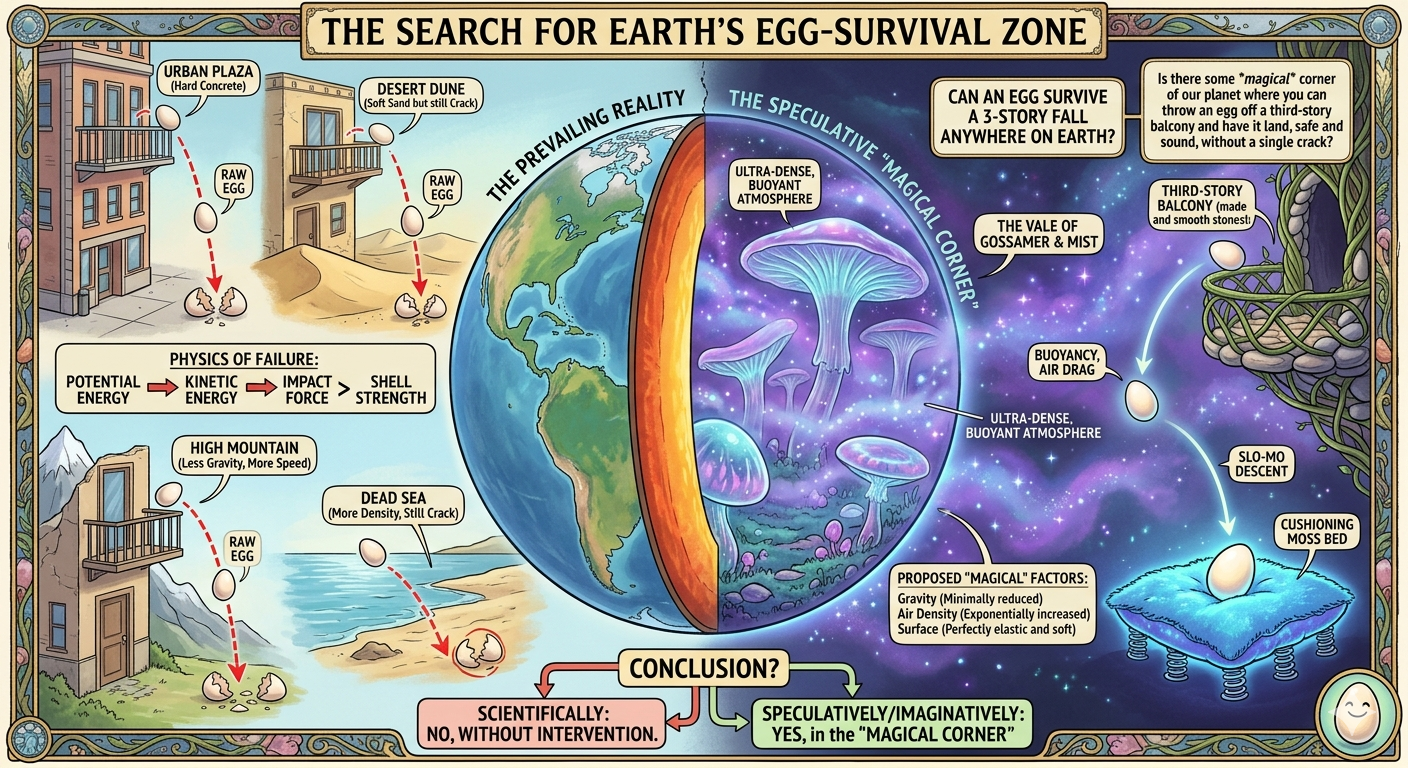
Is there some magical corner of our planet where you can throw an egg off a third-story balcony and have it land, safe and sound, without a single crack?
The Problem
As the egg falls, it gets faster and faster. When it hits the hard pavement, all that kinetic energy has to go somewhere. It stops incredibly quickly, meaning a massive amount of force is applied to the delicate eggshell in a fraction of a second. The force exceeds the shell’s structural strength, and… CRUNCH. Your breakfast is now a sidewalk decoration.
So, for an egg to survive a 3-story drop (roughly 10 meters, or 33 feet), we need to decrease the force it feels upon impact. There are two ways to do this:
- Decrease the final speed.
- Increase the time it takes to stop (cushion the impact).
Terminal Velocity
When an object falls, it’s not just gravity pulling it down. Air is a fluid, and as the egg moves through it, it collides with air molecules, creating an upward force called air resistance or drag.
The faster the egg falls, the greater the air resistance. Eventually, the upward force of air resistance becomes exactly equal to the downward pull of gravity. At this precise moment, the net force on the egg is zero.
Because there is no net force, the egg stops accelerating. It continues to fall, but at a constant, maximum speed. This magical speed is called Terminal Velocity.
Here’s the breakdown of the forces:
- Gravity ($F_g$): The force pulling the object down.
- Air Resistance ($F_d$): The force pushing the object up, opposing its motion.
- Terminal Velocity: The point where $F_d = F_g$, leading to a constant speed.
The key thing to know about terminal velocity is that it’s not the same for everything. It depends on several factors:
- Mass: Heavier objects have a higher terminal velocity because they need more air resistance to balance their weight.
- Surface Area & Shape: A parachute has a low terminal velocity because its large surface area creates huge drag. A streamlined rocket has a high terminal velocity.
- Air Density: This is the big one for our question! The denser the air, the more molecules there are to collide with, and the greater the air resistance. Thicker air = Lower terminal velocity.
Where on Earth is the Air Thick Enough?
So, is there a part of the world with air so incredibly thick that an egg’s terminal velocity would be low enough for it to land gently? Let’s look at the numbers.
A typical chicken egg’s terminal velocity in normal sea-level air is estimated to be around 10 to 20 meters per second (22 to 45 mph). That’s fast. For comparison, a major league fastball travels at about 40 m/s.
To make an egg survive a fall onto hard ground, its terminal velocity would need to be radically lower—perhaps less than 2 m/s. This would require an atmosphere hundreds of times denser than what we have on Earth.
So, How Can You Make an Egg Survive?
If you want to save the egg from a third-story fall without using cushioning, you have to get creative with the rules of physics. Here’s where the “fun” part comes in!
- Change the Temperature: Freezing temperature would freeze the egg and the yolk! Throw it off the top of a mountain on the Siachen Glacier (in Nothern India)! Everything freezes at -40 degrees Celsius. Or in Antarctica or Siberia.
- Change the Surface: Throw it on sand or water!
- Hard boil the Egg: Yes, hard boil the egg!
- Change the Fluid: What if you were not throwing it through air? Water is a fluid over 800 times denser than air. An egg thrown under water into deep water would reach a very low terminal velocity extremely quickly and would almost certainly survive.
- Change the Environment: If you could build a massive, airtight room and fill it with a super-dense, non-toxic gas like Sulfur Hexafluoride (which is about five times denser than air), the terminal velocity would be lower, but probably still not enough. You would need pressure conditions found deep inside a gas giant planet like Jupiter—where the air eventually becomes a liquid-like fluid.
- Engage in the Classic Science Experiment: Since you cannot change the planet, you change the egg’s environment by building a contraption. By building a device, you can use the two principles we discussed:
- Decrease Speed: Use a parachute to dramatically increase surface area, creating massive drag and slashing the terminal velocity.
- Increase Impact Time: Surround the egg with cushioning materials like bubble wrap, cotton balls, sponges, or even a crumpled paper structure (“crumple zones”). These materials compress upon impact, increasing the time it takes for the egg to stop and spreading the force out, protecting the shell.
Fun activity
Now think: would an egg crack if it dropped on Titan? Or our Moon? Or on Jupiter?
Conclusion
So, there are many magical spots on Earth for a free-falling egg to survive a fall.
Now, go forth and engineer some egg-cellent survival pods! Just, you know… maybe do it over grass. Splat!