teaching_llm_applications
Encoders vs. Decoders in Large Language Models
A Comprehensive Guide & Teaching Resource
Welcome to this guide on understanding and teaching the fundamental architectural differences in Large Language Models (LLMs): Encoders and Decoders.
Practical
Part 1: Core Concepts for Your Understanding
To understand modern LLMs, we must start with the Transformer architecture, introduced in the 2017 paper “Attention Is All You Need.” The original Transformer consisted of two parts: an Encoder and a Decoder. Over time, researchers realized that these parts could be uncoupled and used independently depending on the task.
1. The Encoder: The “Reader” (Understanding)
The Encoder’s primary job is to read text and build a deep, rich mathematical representation (embeddings) of its meaning.
- How it works: It uses bidirectional self-attention. This means when processing a specific word (e.g., “bank”), it looks at all the words before it and all the words after it simultaneously to determine the context (e.g., river bank vs. financial bank).
- Analogy: Imagine reading a complex legal document. You don’t just read it word-by-word and instantly react; you read the whole paragraph, look back, look forward, and grasp the overall meaning before answering questions about it.
- Key Characteristic: Excellent at extracting features and understanding context.
- Prominent Models: BERT (Bidirectional Encoder Representations from Transformers), RoBERTa.
- Best Applications: * Text classification (spam detection, sentiment analysis)
- Named Entity Recognition (NER)
- Extractive Question Answering (finding the exact answer span in a text)
- Semantic search and embedding generation
2. The Decoder: The “Writer” (Generation)
The Decoder’s primary job is to generate text, one token (word piece) at a time, based on a given prompt.
- How it works: It uses unidirectional (causal) self-attention. When predicting the next word, it can only look at the words that came before it. It is “masked” from seeing the future, which prevents it from “cheating” during training.
- Analogy: Imagine participating in an improv comedy show or writing a story on the fly. You know everything you’ve said up to this exact moment, and you must generate the very next word based only on that past context.
- Key Characteristic: Excellent at autoregressive text generation.
- Prominent Models: GPT series (OpenAI), LLaMA (Meta), Claude (Anthropic). (Note: Almost all modern popular chat-based LLMs are decoder-only architectures).
- Best Applications:
- Open-ended text generation (chatbots, creative writing)
- Summarization
- Code generation
- Instruction following
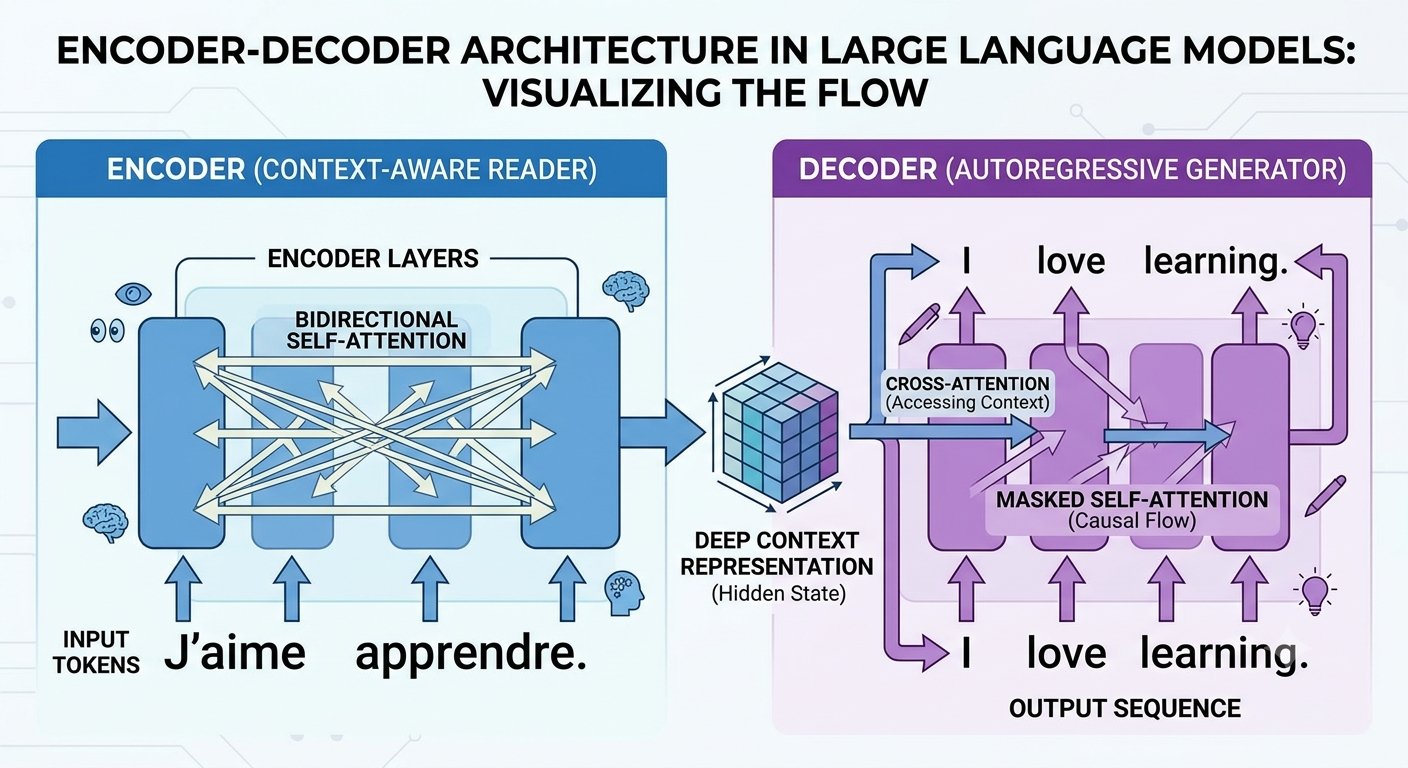
3. Encoder-Decoder: The “Translator” (Sequence-to-Sequence)
This architecture combines both. The Encoder reads the input sequence and compresses it into a rich representation. The Decoder takes that representation and generates an output sequence.
- How it works: The Encoder uses bidirectional attention on the input. The Decoder uses causal attention to generate output, but it also has a “cross-attention” layer that lets it look back at the Encoder’s rich representation.
- Analogy: A professional translator. First, they read the entire sentence in French (Encoder), understand the complete meaning, and then begin writing the sentence out word-by-word in English (Decoder).
- Prominent Models: T5 (Text-to-Text Transfer Transformer), BART.
- Best Applications:
- Machine translation
- Complex abstractive summarization
- Paraphrasing
Part 2: Teaching Framework & Resources
When teaching this to a class focusing on LLM applications, students need to know why this matters to them. The architecture dictates the capabilities, costs, and appropriate use cases of the model they choose for their applications.
Lesson Plan Outline
1. Introduction (15 mins)
- Hook: Why does ChatGPT write so well but sometimes struggle with pure extraction tasks compared to older, smaller models?
- Brief History: Pre-2017 (RNNs/LSTMs) vs. Post-2017 (Transformers).
- Suggested Diagram Idea: Draw a timeline showing the divergence of models (BERT branch vs. GPT branch).
2. Deep Dive: Encoders (20 mins)
- Explain bidirectional attention.
- Interactive Exercise (The “Bank” Exercise): Write the sentence: “I walked to the bank to deposit my check, then sat by the river bank.” Ask students how they know the difference between the two “banks”. Explain that Encoders look at the whole sentence mathematically just like our brains do.
-
Application focus: Discuss why you would use an Encoder (like a lightweight BERT model) for a simple routing app (e.g., categorizing customer support tickets) instead of a massive GPT model. (Focus: Cost, speed, accuracy).
- 🎥 video explaining how masked self-attention works
3. Deep Dive: Decoders (20 mins)
- Explain causal masking / autoregressive generation.
- Interactive Exercise (The Next Word Game): Have the class collectively write a sentence, one word per student. They can only base their word on the previous words spoken. This perfectly simulates Decoder behavior.
- Application focus: Discuss prompting. Why does the order of instructions in a prompt matter to a Decoder? (Because it processes linearly from left to right).
4. Comparing and Choosing (15 mins)
- Create a matrix on the board:
- Task: Sentiment Analysis -> Best Choice: Encoder (BERT)
- Task: Drafting an email -> Best Choice: Decoder (GPT)
- Task: Translating a document -> Best Choice: Encoder-Decoder (T5)
Curated Links & External Resources for Students
Provide these links to your students for further reading:
- “The Illustrated Transformer” by Jay Alammar
- Link: https://jalammar.github.io/illustrated-transformer/
- Why it’s great: The absolute gold standard for visualizing how attention, encoders, and decoders work step-by-step. A must-read for visual learners.
- Hugging Face NLP Course (Chapter 1)
- Link: https://huggingface.co/learn/nlp-course/chapter1/1
- Why it’s great: Provides a practical, high-level overview of Transformers, breaking them down into Encoder, Decoder, and Sequence-to-Sequence models with interactive examples.
- “Attention Is All You Need” (Original Paper)
- Link: https://arxiv.org/abs/1706.03762
- Why it’s great: For advanced students who want to read the foundational text that started the current AI boom.
- Stanford CS224N: Natural Language Processing with Deep Learning
- Link: Search YouTube for “Stanford CS224N”
- Why it’s great: Excellent academic lectures covering the underlying math and architecture of these models.