teaching_theory_computer_science
Introduction
- This is an introduction to theory of computer science
Theoretical Computer Science Teaching Repository
1. Introduction
In this repository, we explore the fundamental concepts of theoretical computer science. Our journey starts with a classic problem—the Bridges of Königsberg—solved by the brilliant mathematician Leonhard Euler, laying the foundation for graph theory.
2. The Bridges of Königsberg Problem
Problem Overview
The city of Königsberg (now Kaliningrad, Russia) was famous for its seven bridges connecting different parts of the city. The problem asked if one could walk through the city, crossing each bridge once and only once.
Historical Significance
This problem was posed in the 18th century and became one of the first to be studied in graph theory. It led to the development of the concept of a graph and paved the way for modern computer science.
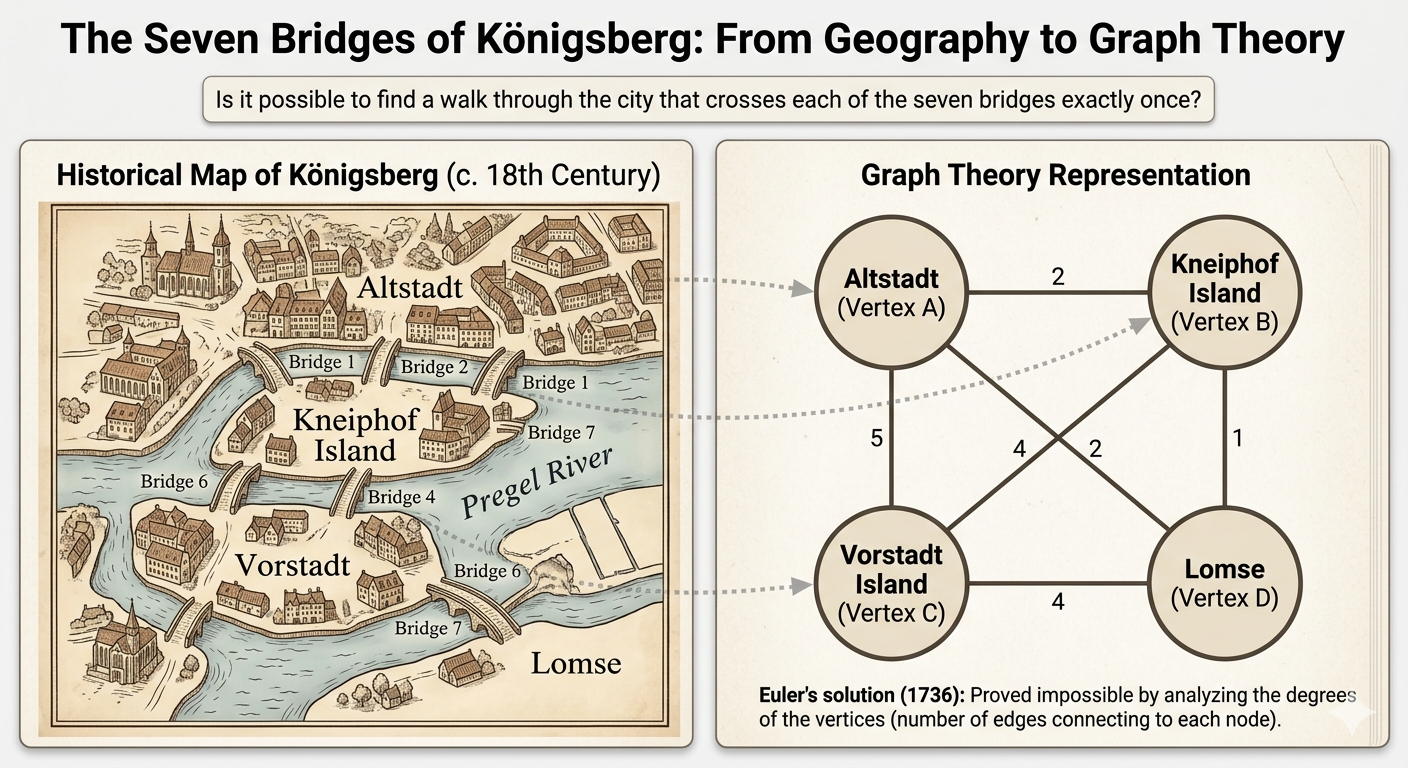
Euler’s Solution
Leonhard Euler solved this problem by representing the city as a graph, where the landmasses were nodes and the bridges were edges. He proved that a walk crossing each bridge exactly once was possible if and only if at most zero or two nodes had an odd degree.
Key Resource Links
- Wikipedia: Bridges of Königsberg
- Euler’s Solution and the Concept of Graphs
- Interactive Graph Theory Lesson (with examples)
3. Graph Theory: Introduction to Nodes and Edges
Graph theory is a cornerstone of theoretical computer science. It models relationships between objects, and it’s crucial for algorithms, networks, and optimization problems.
Key Concepts
- Graph: A set of vertices (nodes) connected by edges (links).
- Degree: The number of edges connected to a node.
- Path: A sequence of edges connecting a sequence of vertices.
- Eulerian Path: A path that uses every edge exactly once.
Key Resource Links
- Introduction to Graph Theory (by Douglas West)
- Graph Theory in Computer Science (MIT OpenCourseWare)
- Visualizing Graph Algorithms (by Nick Parlante)
4. Exercises and Problems
- Exercise 1: Identify the degrees of each node in the Königsberg graph and determine if an Eulerian path is possible.
- Exercise 2: Implement a simple graph traversal algorithm (e.g., depth-first search) in a programming language of your choice.
- Exercise 3: Explore other historical puzzles solved by graph theory, such as the Game of Seven Bridges or social network mapping.