AI_for_school_students
Creative Thinking & Logic Activities for Rural Classrooms
This page contains two highly visual, language-agnostic learning activities designed to serve as warm-ups for school-age students, specifically optimized for rural classroom settings where resource constraints exist but creative potential is high.
The goal of these worksheets is to unlock fluid intelligence, pattern recognition, and lateral thinking without requiring advanced reading, writing, or mathematical prerequisites.
Activity 1: Abstraction and Reasoning Corpus (ARC) Challenge
File Focus: Visual Induction & Logic Progression
About the Concept
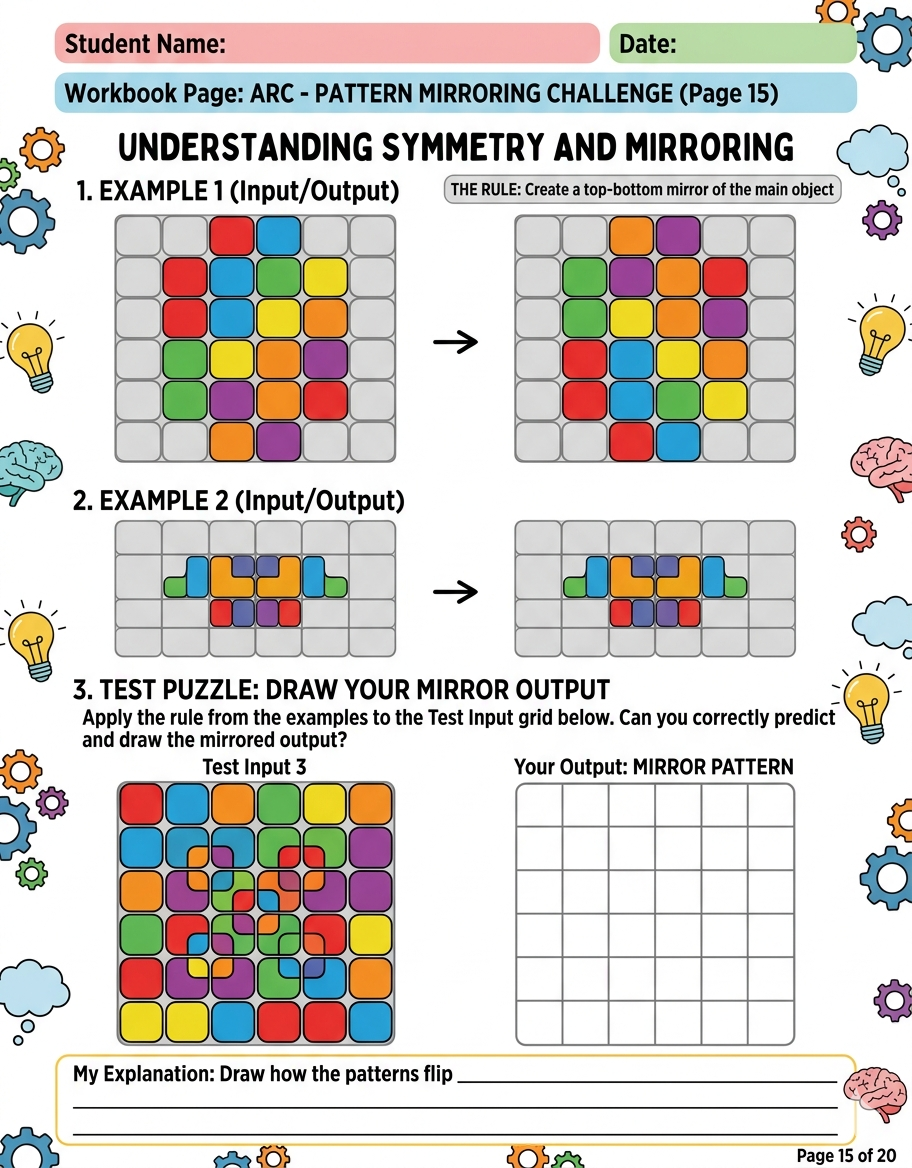
Based on François Chollet’s Abstraction and Reasoning Corpus (ARC), this activity tests a student’s ability to deduce implicit rules from visual examples. Because real ARC puzzles don’t use verbal instructions, they are ideal for bridging language divides. This specific worksheet focuses on Symmetry and Mirroring using color-blocked grids.
Classroom Execution Guide
- The Discovery Phase: Do not tell the students what the “rule” is initially. Direct their attention to Example 1 and Example 2. Ask them: “What magic trick happens to the shape when it crosses the arrow?”
- The Guided Discussion: Help them notice that the top colors move to the bottom, and the bottom colors move to the top (Horizontal/X-Axis Mirroring).
- The Test Case: Challenge students to independently color or draw the final blank 6x6 grid based on the pattern provided in Test Input 3.
- Reflection: Have them write or speak their explanation in the “My Explanation” box at the bottom.
Answer Key for Teachers
- The Rule: Top-to-bottom spatial reflection (vertical flip across a central horizontal axis).
- The Solution for Grid 3: * Row 1 (Top) becomes identical to the original Row 6 (Yellow, Purple, Red, Red, Blue, Blue).
- Row 2 becomes identical to the original Row 5 (Red, Purple, Red, Red, Purple, Yellow).
- …and so forth, completely reversing the row order while keeping the horizontal pixel sequence intact.
Activity 2: The Great Egg Drop Challenge
File Focus: Multi-Angle Problem Solving & Riddle Deconstruction
About the Concept
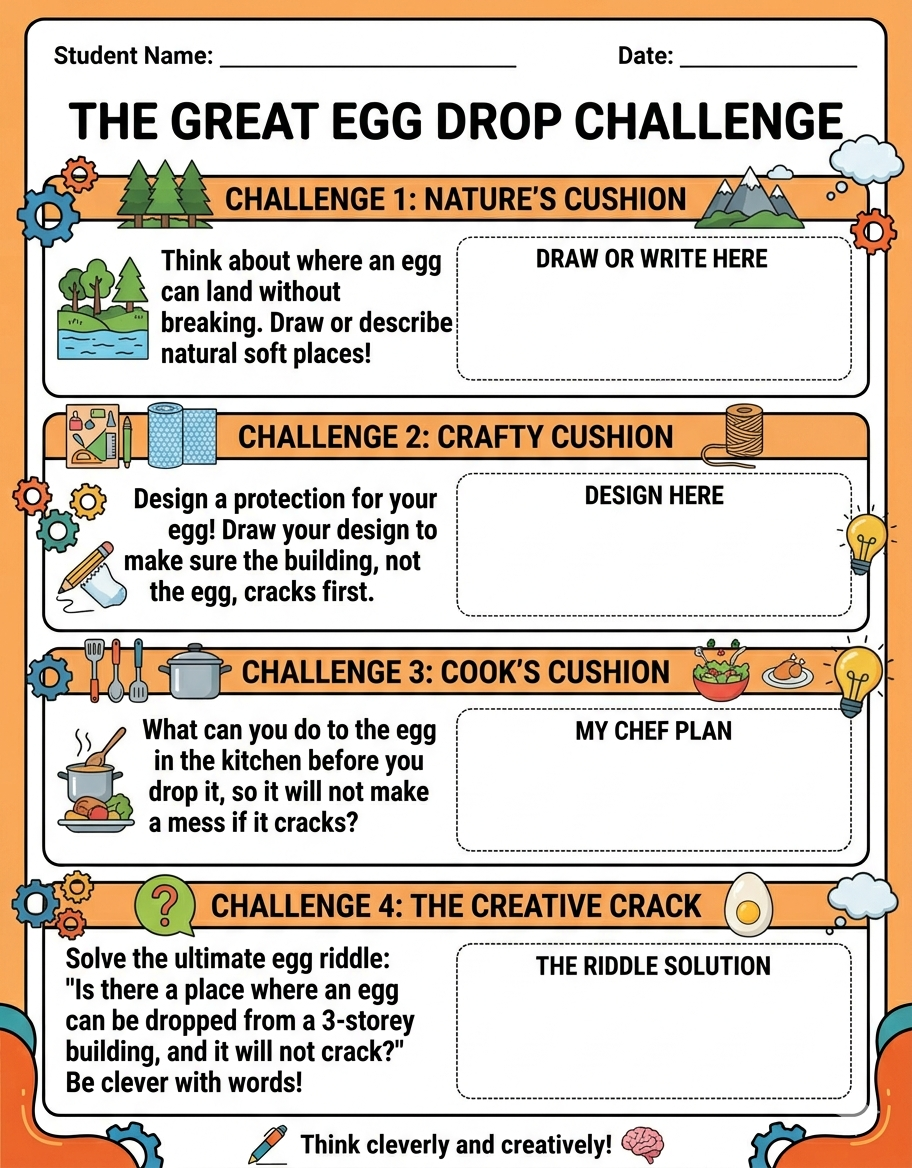
This worksheet addresses a classic open-ended physics and wordplay riddle: “Is there a place on Earth where an egg can be dropped from a three-story building and it will not crack?” Instead of looking for a single scientific answer, it pushes children to think across four distinct dimensional boundaries.
The Four Challenge Dimensions
- Challenge 1: Nature’s Cushion (Geography/Science)
- Objective: Think about natural terrains that act as energy absorbers.
- Expected Ideas: Dropping the egg into a deep river, a soft pile of agricultural hay/straw, or a loose sand dune.
- Challenge 2: Crafty Cushion (Engineering/Design)
- Objective: Creative structural design using local materials.
- Expected Ideas: Building a parachute out of old rags, packing the egg inside a thick bundle of coconut husks, or using waste paper to create a suspension cradle.
- Challenge 3: Cook’s Cushion (Kitchen Chemistry)
- Objective: Modifying the properties of the object itself to bypass constraints.
- Expected Ideas: Boiling the egg until it is hard and bouncy, or freezing it into a solid block of ice so it won’t create a liquid mess.
- Challenge 4: The Creative Crack (Lateral Thinking & Language)
- Objective: Spotting semantic traps in problem statements.
- The Secret: The prompt asks if “it” will crack. The heavy concrete ground or the Earth itself will not crack when hit by an egg!