AI_for_school_students
AI for school students in the Global South

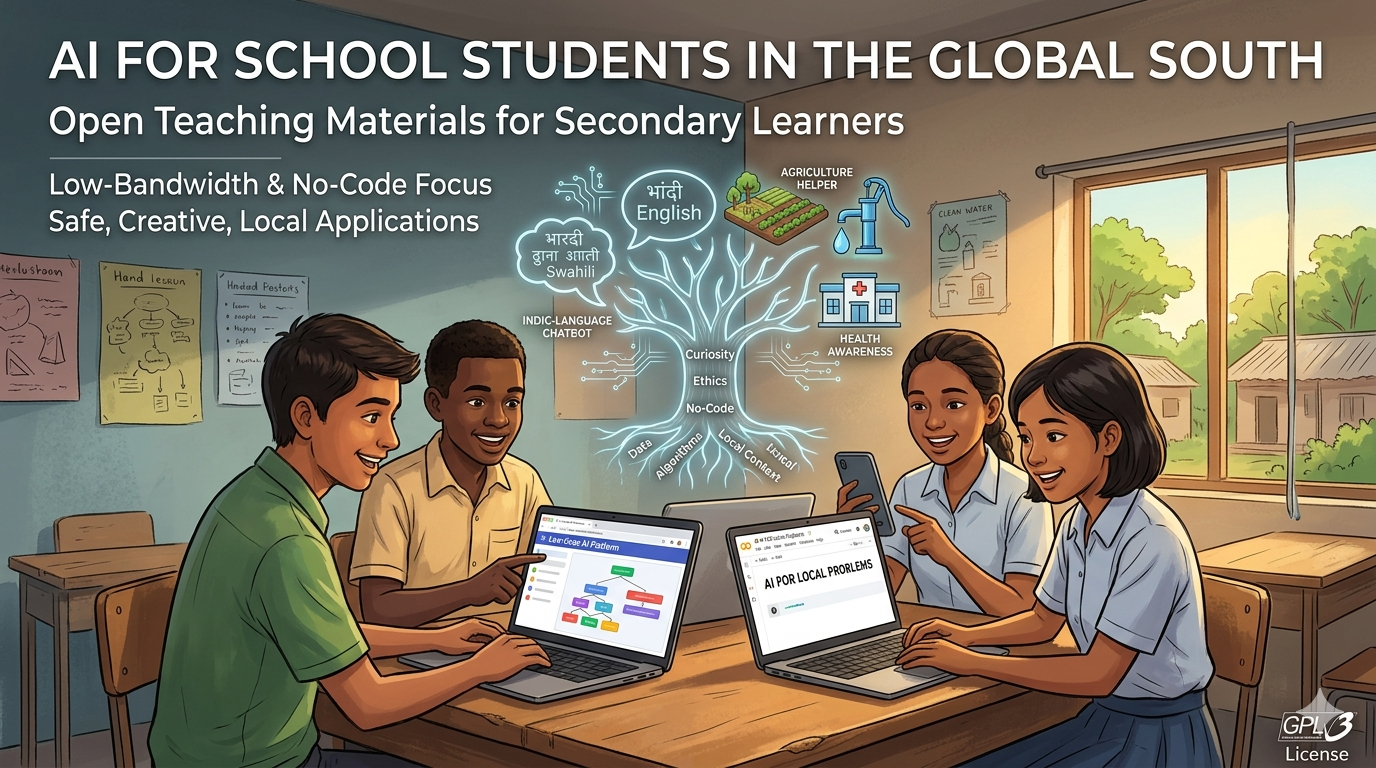
Open teaching materials to help secondary-school learners (roughly ages 14–18) understand and use AI safely and creatively—designed for classrooms in the Global South, where connectivity, devices, and language resources vary widely.
Instructor: Soumya Banerjee
Course site: https://neelsoumya.github.io/AI_for_school_students/
Contact: neel.soumya@gmail.com · Webpage
Why this course
AI is already part of students’ lives—search, translation, homework help, social media. This course helps learners understand what AI is, use it thoughtfully, and build small projects that matter in their own communities—not only in wealthy labs with fast GPUs and English-only data.
We emphasise:
- Low-bandwidth and browser-first tools (Google Colab, free tiers of chatbots, Hugging Face Spaces)
- No-code and low-code paths before heavy programming
- Local languages and contexts (e.g. Indic-language chatbots, village- or school-level problems)
- Critical thinking and ethics—bias, privacy, misinformation, and who benefits from AI
- Creativity and play—puzzles, scavenger hunts, rapid prototypes, hackathons
Who it is for
| Learners | Secondary-school students; also suitable for teachers, clubs, and outreach workshops |
| Prerequisites | Curiosity; basic digital literacy. Programming is introduced gradually—not required on day one |
| Duration | Flexible: ~8–12 weeks at 2–3 hours/week (class + activities), or a shorter bootcamp |
| Setting | Schools, science clubs, maker spaces, and online cohorts across the Global South |
What students will learn
By the end, learners should be able to:
- Explain—in plain language—what AI is, what machine learning does, and what AI cannot do reliably
- Use no-code and low-code tools to explore data, visualise ideas, and prototype apps
- Work with large language models (LLMs) through clear prompt engineering and fact-checking
- Apply responsible AI ideas: fairness, privacy, safety, and environmental impact
- Design a small team project (e.g. a chatbot, dashboard, or community tool) and present it clearly
Design principles (Global South)
- Start accessible: phones and shared laptops are enough for many activities; Colab and browser tools reduce install burden
- Context-first: examples from agriculture, health awareness, climate, local history, and everyday school life—not only US/EU case studies
- Languages matter: encourage prompts and prototypes in students’ home languages where tools allow
- Verify, don’t trust: teach checking AI answers against textbooks, elders, and trusted sources
- Open materials: reuse, translate, and adapt these files under the repo license
Course materials (table of contents)
Core files in this repository:
Learning Objectives:
- Use AI assistants (ChatGPT/Claude) to solve problems
Course Materials (Table of Contents)
Course content and materials can be found in the following files:
🐣 Warmup activities for creativity
🚀 Basics of AI
- Basics of AI for lay people and interactive visualizations of how neural networks work based on resources here
🎮 💡 🛠️ Activities
- Coding and visualization in Google Colab for beginners and lowcode (ipywidgets,streamlit and superintelligence task)
- Exercises and activities in Google Colab: hunting for the source of an epidemic
- Solving puzzles and creative problem solving using AI. Also ask students to solve problems in their village using generative AI.
🧩 No code tools
- Prompt engineering
- No code tools
- Activities with ChatGPT/Gemini
- 🎮 Activity using Claude to design a chatbot deployed on 🤗 Huggingface with code here
💻 Introduction to coding
🎮 💻 Coding activities
- Design your own Indic language Sarvam chatbot to translate from your language
- Rapid prototyping using GenAI and streamlit
🎮 Coding
⚠️ More advanced topics
⚠️ Yet more advanced topics
- Basics of unsupervised machine learning using animations and widgets and PCA in your browser and visual explanations of PCA and visualizing the Swiss roll data
- Basics of supervised machine learning and here
Large language models
Ethics
Projects
Code folder
Suggested 12-week outline
| Week | Theme | Focus |
|---|---|---|
| 1 | What is AI? | Demos, myths vs facts, AI in daily life |
| 2 | How learning machines work | Simple analogies, interactive neural-net visuals |
| 3 | No-code AI | Try chatbots and no-code platforms; compare outputs |
| 4 | Data & stories | Load small datasets in Colab; charts that answer a question |
| 5 | Visualisation | Good and bad graphs; tell a story from local data |
| 6 | Large language models | What LLMs are; limits, hallucinations, checking sources |
| 7 | Prompt engineering | Clear prompts; few-shot examples; peer review of prompts |
| 8 | Maths & statistics (light) | Mean, variation, uncertainty—enough to read AI claims critically |
| 9 | Ethics & responsible AI | Bias, privacy, deepfakes, who owns data |
| 10 | Design & HCI | Sketch an app; accessibility; user testing with classmates |
| 11 | Hackathon (build) | Teams: chatbot, translator, or tool for a local problem |
| 12 | Hackathon (share) | Demos, reflections, what you would do differently |
Teachers can compress weeks 8–10 or swap in exams and quizzes where needed.
Concise pathway for rural students in India
- Start with the course overview and
materials/setup.mdso teachers can plan around devices, connectivity, and language support. - Read
materials/AI_basic.mdfirst to introduce what AI is, everyday examples, and simple visual explanations. - Use
materials/nocodetools.mdandmaterials/prompt_engineering.mdto explore chatbots and prompt skills with free-tier LLMs like ChatGPT, Gemini, or Claude. - Run
materials/scavenger_hunt.mdfor a local, guided activity andmaterials/colab.mdfor low-code exercises when a laptop and internet are available. - Introduce basic programming gently with
materials/code.md; keep the focus on logic and use browser-based Python resources when needed. - Build a simple community chatbot or translation helper with
materials/chatbot.md, then prototype it usingmaterials/rapid_prototyping.mdif possible. - Add responsible AI and HCI lessons with
materials/HCI.md, and discuss fairness, privacy, safety, and checking AI outputs. - If time permits, use
materials/basic_mathematics_stats.mdto cover light data awareness: mean, variation, uncertainty, and how to question AI claims. - Choose a small local project from
materials/projects.mdthat is easy to demonstrate and useful for the school or community. - Follow the 12-week outline flexibly, adapting to device sharing, intermittent internet, and local language needs.
Sample hackathon projects
Ideas aligned with Global South contexts (see projects.md for more):
- School or community helper chatbot—FAQs in a local language, study tips, or health awareness (with clear “not a doctor” disclaimers)
- Local problem solver—use GenAI to brainstorm solutions for waste, water, transport, or farming; document what you verified
- Small language model exploration—finetune a tiny open model (e.g. Llama 3.2 1B/3B, Phi-3.5-mini) in Colab with Unsloth
- Dashboard—Streamlit app visualising public data (weather, prices, school metrics)
- Creative AI—science fiction or art projects that question how AI should be used
Assessment (flexible)
| Component | Suggested weight | Notes |
|---|---|---|
| Weekly activities & reflections | 30% | Completion and effort; cite if AI helped |
| Quizzes | 15% | Concepts, not memorisation of tool names |
| Participation & peer feedback | 15% | Labs, prompt reviews, hackathon teamwork |
| Midterm mini-project | 20% | e.g. prompt portfolio + short write-up |
| Final hackathon | 20% | Working demo + 5–10 min presentation |
Academic integrity: Using AI tools is encouraged; students must review, correct, and cite AI assistance. Submitting unedited AI text as their own work is not acceptable.
Required tools
- Web browser and internet (intermittent OK for some units if materials are downloaded ahead)
- Free accounts: Google (Colab), GitHub, and at least one LLM (ChatGPT, Claude, or Gemini free tier)
- Optional: VS Code, Git—see setup
- No personal GPU required for core activities
For teachers and facilitators
- Adapt examples to your curriculum, language, and bandwidth
- Pair students for device sharing; cache Colab notebooks when the network is poor
- Use AI pedagogy notes for constructionist, Papert-style activities and grant/portfolio ideas
- Report issues or suggest modules via GitHub Issues
Office hours / forum: Set locally (TBD per institution).
Inspiration
- Stanford: Demystifying data (Kristin Sainani)
- Learn Prompting
- fast.ai — practical, accessible AI
- Seymour Papert’s constructionism and playful computing (see pedagogy notes in repo)
Acknowledgments
Materials adapt and link to open resources from Anthropic, Hugging Face, Cambridge Bioinformatics Training, and many community educators. Thanks to students and teachers who test these activities in real classrooms.
License & contributing
This repository is licensed under GPL v3 (see LICENSE). You are welcome to fork, translate, and localise content; please keep attribution and share improvements when you can.
Instructor Information
- Name: Soumya Banerjee
- Email: [neel.soumya@gmail.com]
- Website: Webpage
Acknowledgement for funders
Forthcoming