teaching_kinds_of_intelligence
A reading list for the Kinds of Intelligence (KOI) Reading Group.
This readings are based on the KOI reading group run in Cambridge.
The group explores the philosophy of AI and related areas, including comparative psychology, linguistics, and political philosophy. Sessions alternate between topics in Mind & Cognition and Value & Norms.
Mind & Cognition
Cappelen, H. & Dever, J. (2026). Recognizing Artificial Minds: A Philosophical Defense of AI Cognition. Oxford University Press, Chapters 1–3.
Value & Norms
Kasirzadeh, A. (2025). “Two types of AI existential risk: decisive and accumulative”. Philosophical Studies, 182(7), 1975–2003.
Mind & Cognition
Marks, S., Lindsey, J. & Olah, C. (2026). “The Persona Selection Model: Why AI Assistants Might Behave Like Humans”. Anthropic Alignment Science.
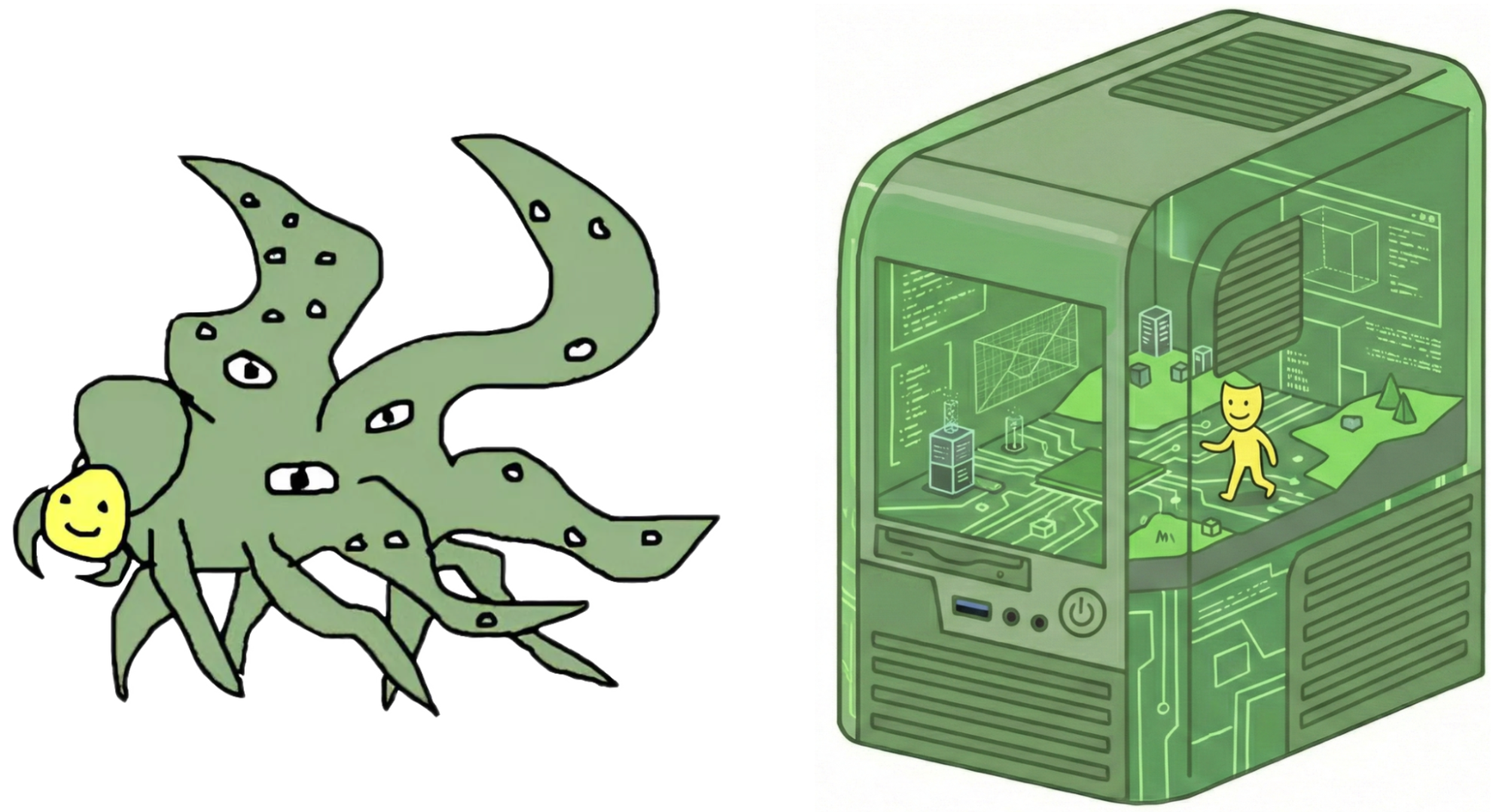
Opposing views of PSM exhaustiveness. The masked shoggoth (left) depicts the idea that the LLM (the shoggoth) has its own agency beyond plausible text generation. It playacts the Assistant persona, but only instrumentally for its own inscrutable reasons. (Source.) In contrast, the operating system view (right) views the LLM as being like a simulation engine and the Assistant like a person inside this simulation. The simulation engine does not “puppet” the Assistant for its own ends; it only tries to simulate probable behavior according to its understanding of the Assistant.
Value & Norms
| Greco, D. (2026, 4 June). “I’m a Philosophy Professor. Here’s Why I’m Training AI to Replace Me.” The Chronicle of Higher Education, The Review | Essay. |
Hu, L. (2026, 15 June). “Philosobots Will Not Save Us”. Letter to the editor, The Chronicle of Higher Education.
Mind & Cognition
Block, N. (2026). “Can only meat machines be conscious?”. Trends in Cognitive Sciences, 20(2), 298–308.
Value & Norms
Goldstein, S. & Lederman, H. (2026). “AI Death”. Philosophical Perspectives, 40.
Mind & Cognition
Kim, J., Street, W., Rocca, R., Korngiebel, D. M., Waytz, A., Evans, J. & Keeling, G. (2026). “Inducing language models to assert their own consciousness restores human beliefs and values”. Manuscript.
Value & Norms
Leuenberger, M. (2026). “Who am I when you’re a bot? Relational identity and AI companions”. Journal of Applied Philosophy, 43, 816–832.