teaching_llm_applications
Different kinds of attention
- Multi-Head Attention (MHA)
- Grouped-Query Attention (GQA)
- Multi-Query Attention (MQA)
Multi-Query-Attention (MQA)
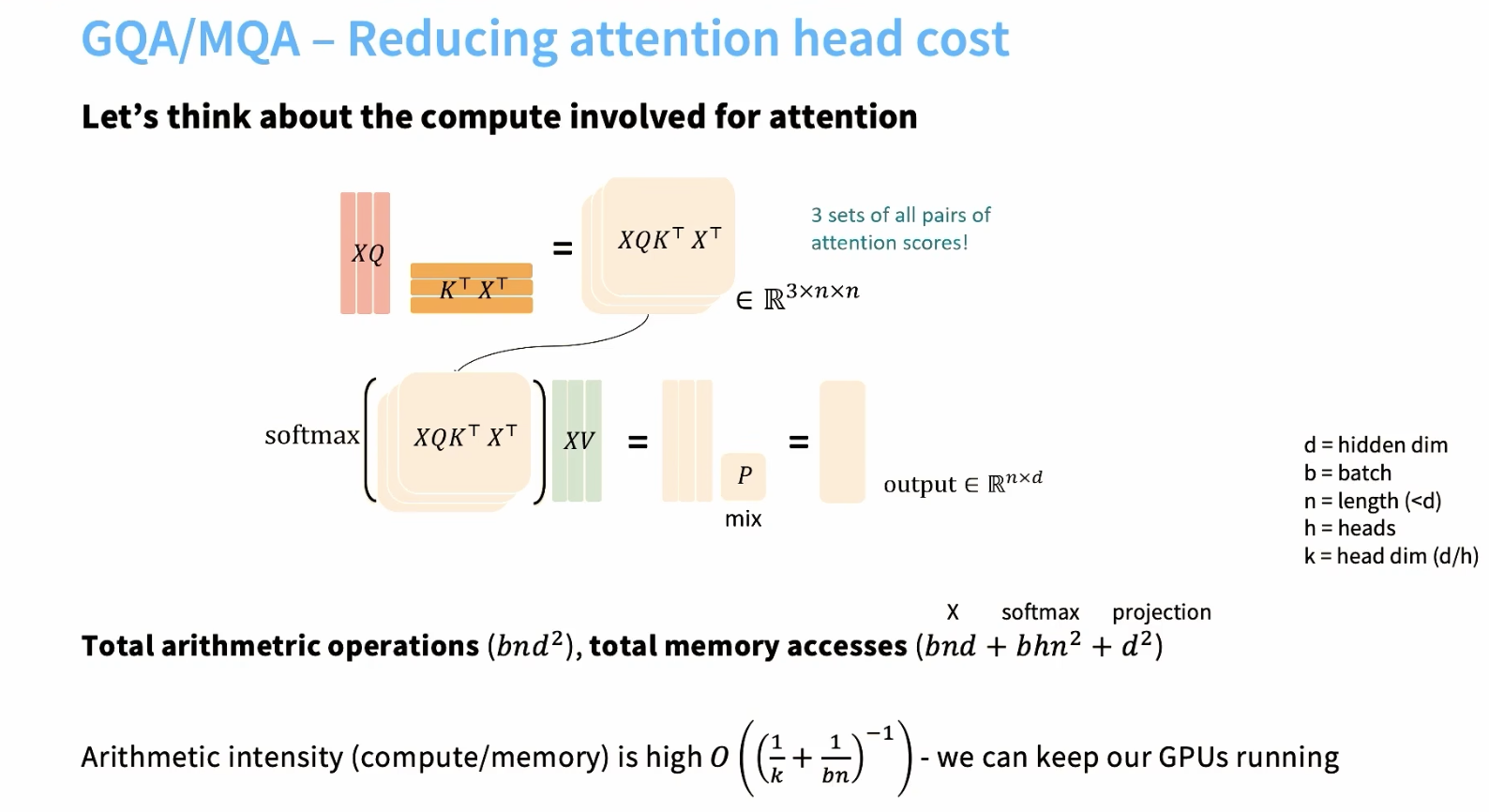
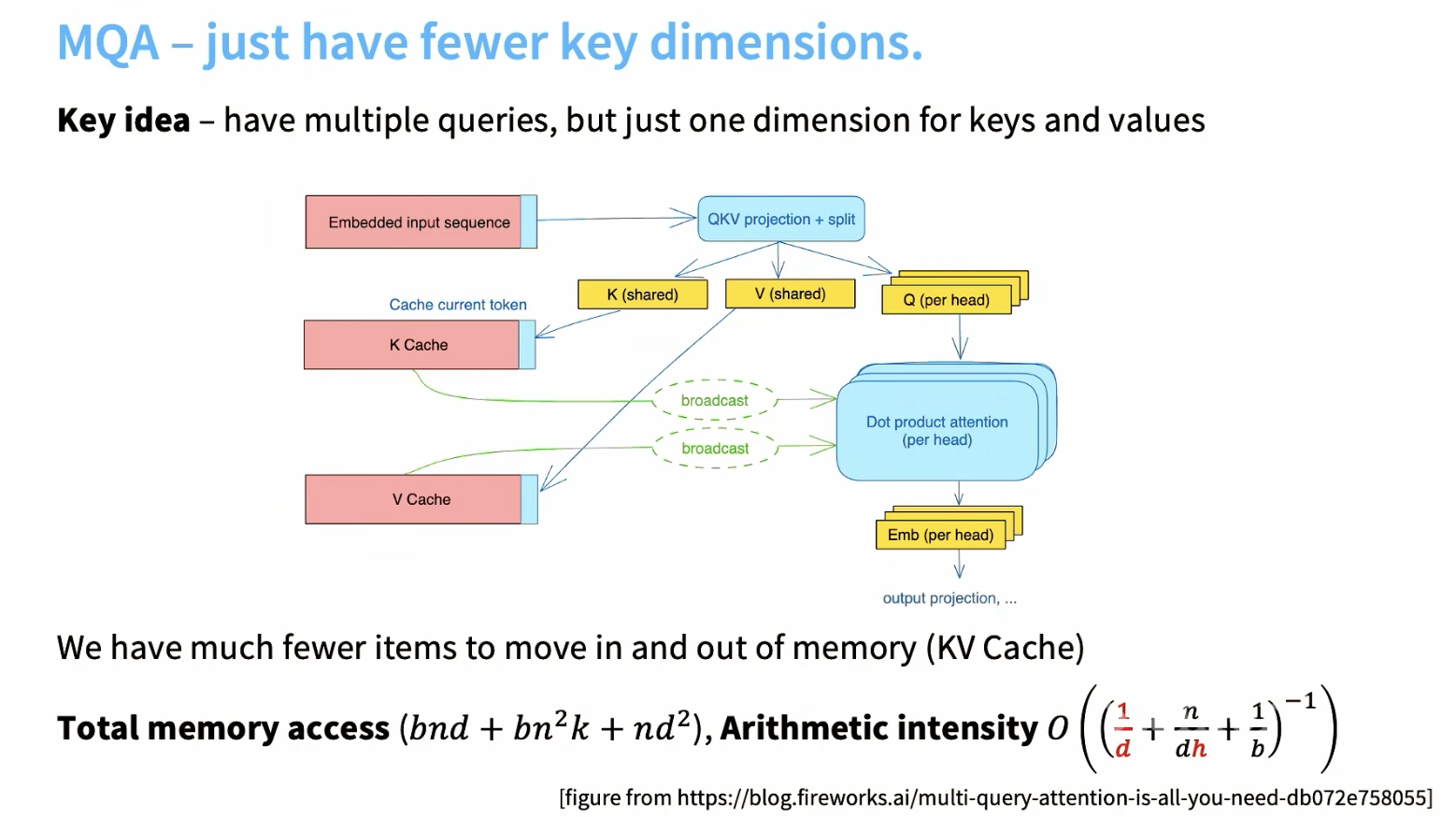
Reading VERY GOOD
Intuition
Think of attention as a team of researchers trying to answer questions using a library: Queries are the questions asked, Keys are book index topics, and Values are the actual textbook contents.
Multi-Head Attention (MHA)
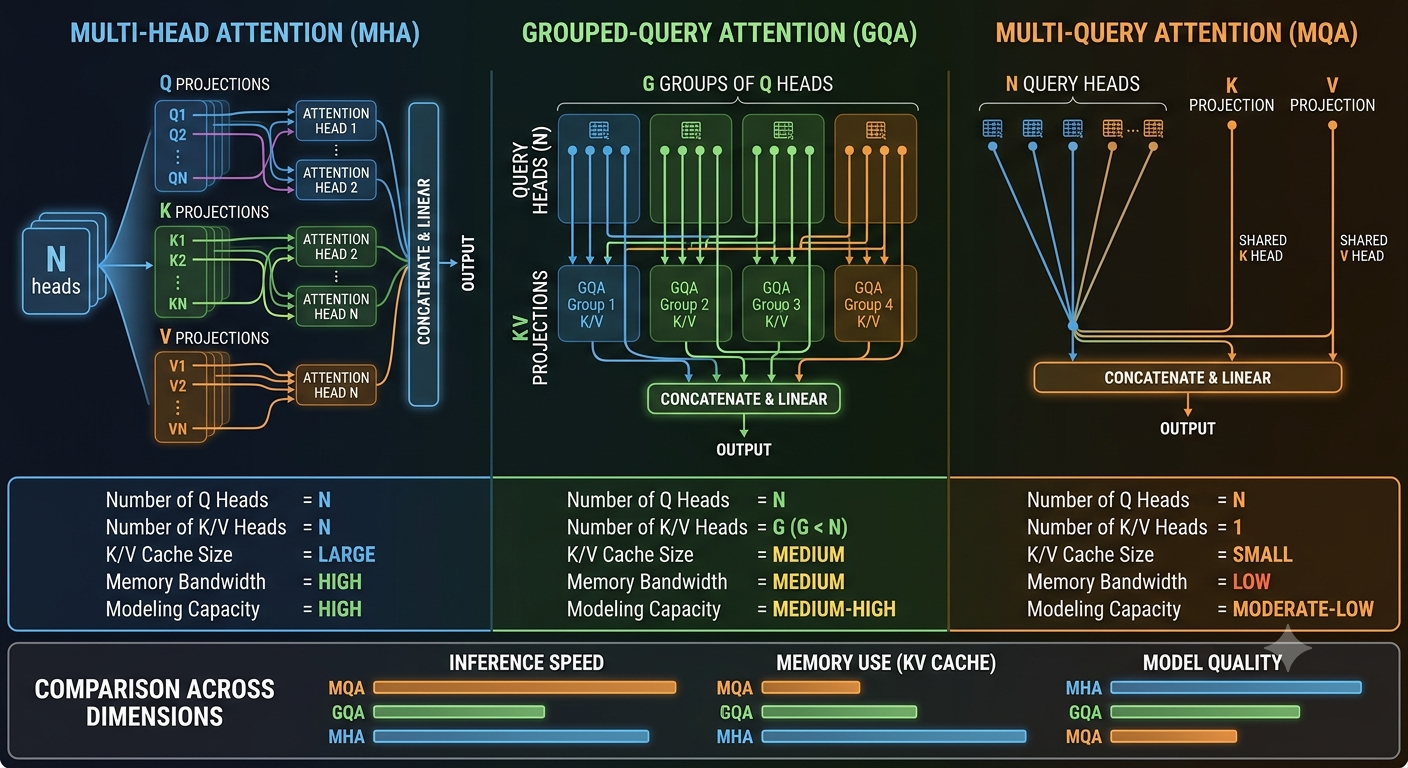
- Concept: Every Query head gets its own dedicated Key and Value head.
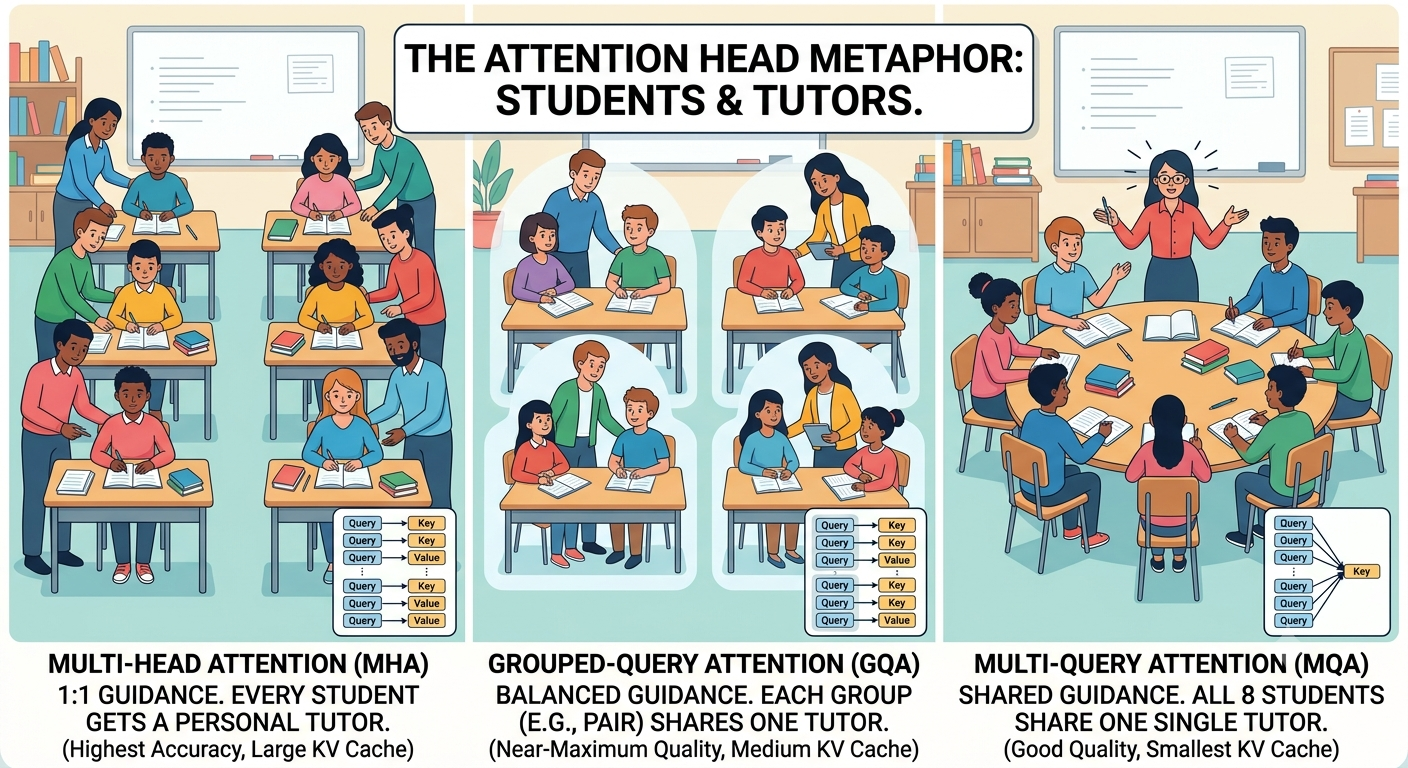
- Classroom Analogy: Imagine 8 students working on a project, and every single student gets their own personal tutor.
- Takeaway: Highest accuracy and detail, but extremely slow and memory-intensive because every tutor needs room to work.
Multi-Query Attention (MQA)
- Concept: All Query heads share a single Key and Value head.
- Classroom Analogy: Imagine 8 students working on a project, but all 8 students have to share one single tutor.
- Takeaway: Ultra-fast and light on memory, but quality drops because one tutor gets overwhelmed managing everyone’s queries.
Grouped-Query Attention (GQA)
- Concept: Query heads are split into small clusters, and each cluster shares a Key and Value head.
- Classroom Analogy: Imagine 8 students split into 4 pairs, where each pair shares one tutor.
- Takeaway: The “Goldilocks” solution. It delivers almost the same quality as MHA while retaining most of MQA’s speed and low memory footprint (used in models like Llama 3).
| Feature | Multi-Head (MHA) | Grouped-Query (GQA) | Multi-Query (MQA) |
|---|---|---|---|
| Analogy Setup | 1 tutor per student | 1 tutor per small group | 1 tutor for the whole class |
| Memory Usage | Very High | Low–Medium | Extremely Low |
| Speed | Slow | Fast | Ultra Fast |
| Model Quality | Maximum | Near-Maximum | Reduced |
Resource on GPUs
- See chapter on GPUs
Deep dive
- frame the progression as an evolution driven by real-world hardware limits rather than abstract math.
- Self-Attention (The Core Idea): Start with sentence context. In “The animal didn’t cross the street because it was too tired,” self-attention is the spotlight mechanism that lets “it” focus on “animal” instead of “street.”
- Multi-Head Attention (MHA): Explain that words have multiple relationships at once. One head tracks grammar (subject-verb), another tracks pronouns, and a third tracks tone. Multiple heads let the model look at the sentence through different lenses simultaneously.
- The Memory Wall (The Bottleneck): Introduce Inference Hardware. Storing all those distinct memory heads (the Key-Value Cache) for long conversations consumes massive GPU memory, making MHA slow and expensive to run in production.
- MQA & GQA (Engineering Trade-offs): Frame MQA as the extreme memory-saving shortcut, and GQA as the modern “Goldilocks” sweet spot used in models like Llama 3.
Whiteboard Memory Trick Use a quick visual formula to show how memory scales during generation:
- MHA: $N$ Queries $\rightarrow$ $N$ Keys / $N$ Values (Heavy Memory)
- GQA: $N$ Queries $\rightarrow$ $G$ Groups of Keys/Values (Balanced)
- MQA: $N$ Queries $\rightarrow$ $1$ Shared Key / $1$ Value (Ultra-Light)
5-Minute Classroom Activity Give students the sentence: “The chef cooked the soup because it was cold.” Ask them to map out what two distinct “heads” are looking at simultaneously:
- Head 1 (Grammar Head): Connects the verb “cooked” back to “chef.”
- Head 2 (Context Head): Connects the pronoun “it” back to “soup.”
This bridges the gap between human intuition and why models need multiple projections before jumping into code.
🎮 Practical activity
- Practical also available here
import torch

# Common dimensions
batch_size = 1
seq_len = 128
num_q_heads = 8
head_dim = 64

print("=== 1. MULTI-HEAD ATTENTION (MHA) ===")
num_kv_heads_mha = 8  # 1:1 ratio (8 Q heads, 8 KV heads)

q_mha = torch.randn(batch_size, num_q_heads, seq_len, head_dim)
k_mha = torch.randn(batch_size, num_kv_heads_mha, seq_len, head_dim)

print(f"Q shape: {list(q_mha.shape)}")
print(f"K shape: {list(k_mha.shape)} <-- Full memory footprint (8 heads)\n")

print("=== 2. GROUPED-QUERY ATTENTION (GQA) ===")
num_kv_heads_gqa = 2  # 4:1 ratio (8 Q heads share 2 KV heads)
group_size = num_q_heads // num_kv_heads_gqa

q_gqa = torch.randn(batch_size, num_q_heads, seq_len, head_dim)
k_gqa = torch.randn(batch_size, num_kv_heads_gqa, seq_len, head_dim)

print(f"Q shape:         {list(q_gqa.shape)}")
print(f"K shape (Cache): {list(k_gqa.shape)} <-- 75% smaller memory footprint!")

# Expand Key heads to match Query heads right before matrix multiplication
k_gqa_expanded = k_gqa.repeat_interleave(group_size, dim=1)
print(f"K shape (Math):  {list(k_gqa_expanded.shape)} <-- Expanded for dot-product")
-
Tracking the head dimension ($N_{\text{heads}}$) directly reveals how Grouped-Query Attention reduces GPU memory overhead during generation compared to Multi-Head Attention.
-
Key Takeaways to Point Out to Students
- Memory Cache Shape: MHA stores
[1, 8, 128, 64]tensors in GPU VRAM, whereas GQA only stores[1, 2, 128, 64]. This 4x reduction in KV cache size allows LLMs to process much larger context windows. - The Trick (
repeat_interleave): GQA saves memory in VRAM, but briefly duplicates the Key/Value heads along the head dimension right before computing dot-product attention so matrix shapes still align: $(1, 8, 128, 64)$.