teaching_llm_applications
Lecture Notes: FlashAttention & Memory-Aware AI Architectures
-
Also see GPUs and Flash Attention
Summary
-
Tiling and recomputation
-
Recall: Attention is 3 matrix multiplies and a softmax
-
Tiling for KQV matrix multiply
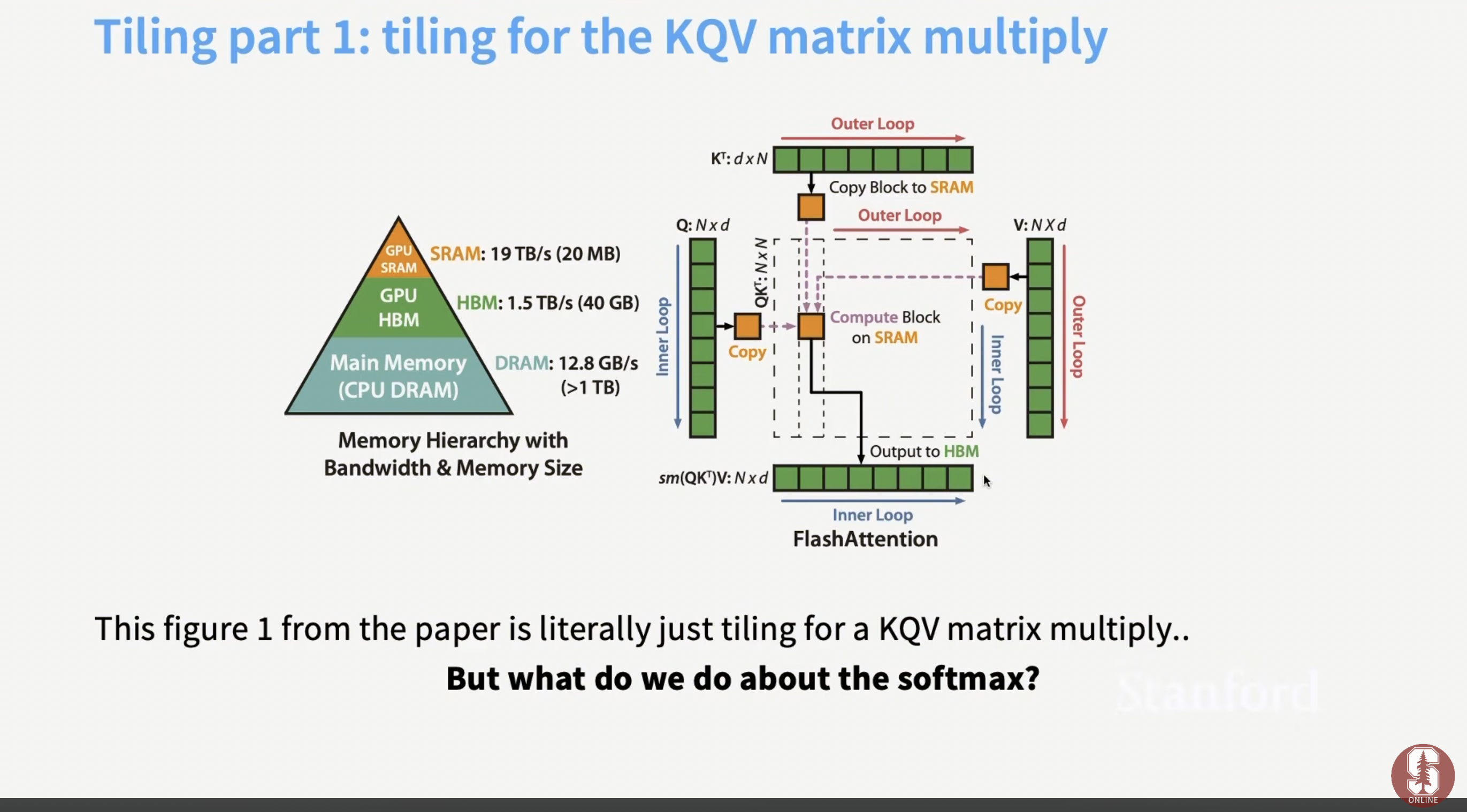
-
softmax?
-
online softmax
-
calculate softmax tile-by-tile
-
incrementally update the max and setup a telescoping sum
-
forward pass in flash attention in HBM and SRAM
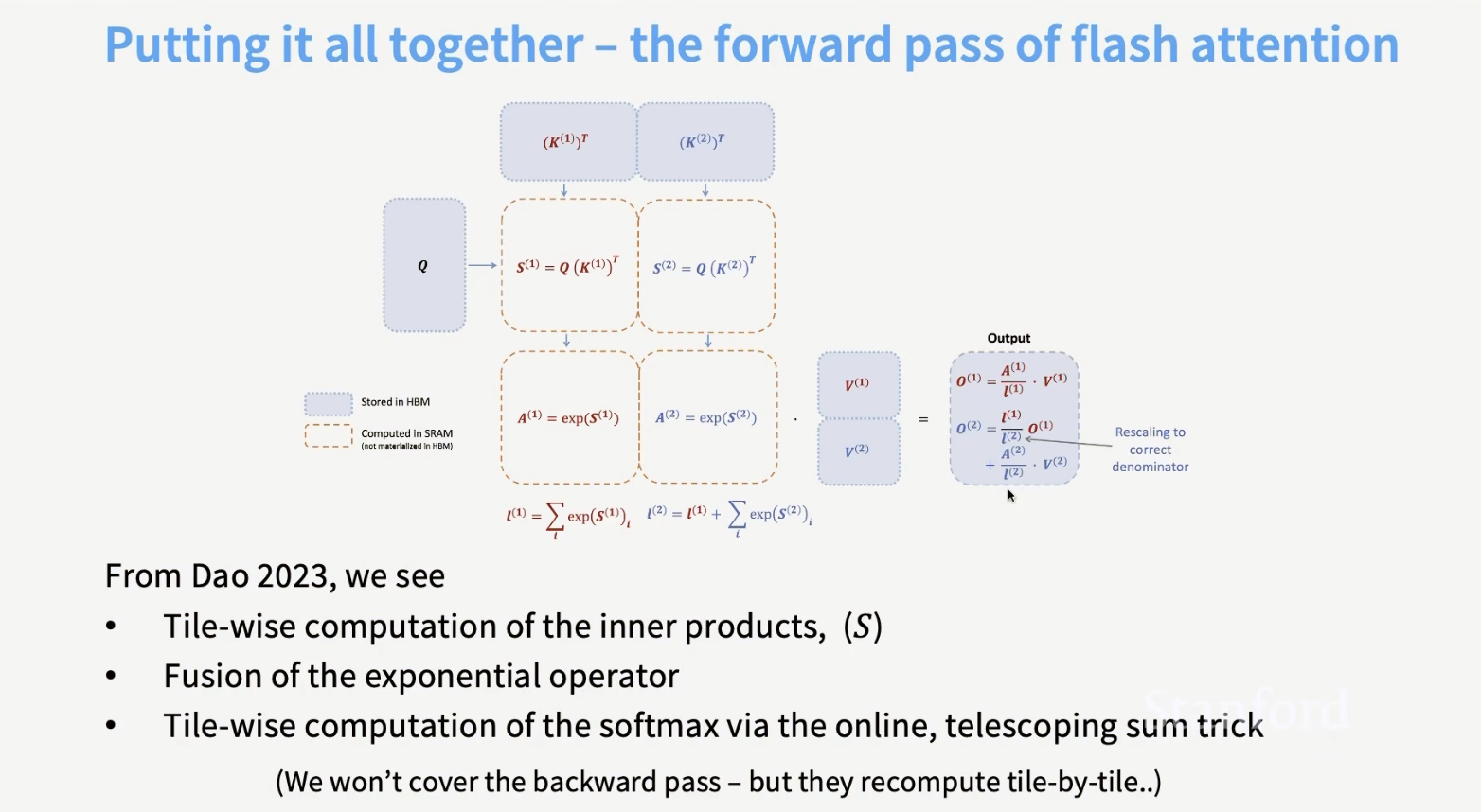
- recomputation: do not store activations in memory, just recompute on backward pass
1. Introduction: The Bottleneck in Modern LLMs
When discussing transformer architectures, the immediate focus is often on the $O(N^2)$ computational complexity of the self-attention mechanism. However, for practical implementation, the true bottleneck is often the Memory Wall—the widening gap between computational speed (FLOPs) and memory bandwidth.
Standard attention materializes the entire $N \times N$ attention matrix on the GPU’s High Bandwidth Memory (HBM). For long sequences, reading and writing this massive matrix to HBM takes more time than the actual mathematical operations.
FlashAttention is an IO-aware, exact attention algorithm. It does not approximate the attention mechanism; rather, it fundamentally restructures how the data moves through the GPU’s memory hierarchy to minimize expensive HBM accesses.
2. The GPU Memory Hierarchy (Pedagogical Visualization)
Teaching Note: When explaining this to students, utilize Bertin’s visual variables to map these concepts. Use size to represent capacity and color intensity/saturation to represent bandwidth speed.
To understand FlashAttention, we must model the GPU memory differently:
- HBM (High Bandwidth Memory): Large capacity (e.g., 40GB-80GB), but relatively slow access.
-
SRAM (Static RAM): Very small capacity (e.g., 20MB per streaming multiprocessor), but blisteringly fast.
-
Standard attention reads $Q, K, V$ from HBM, computes $S = QK^T$, writes $S$ back to HBM, reads it again to compute softmax, writes it back, etc.
- 🧩 🚀 It is heavily
memory-bound.
3. The Core Mechanisms of FlashAttention
FlashAttention solves the IO bottleneck using two primary techniques: Tiling and Recomputation.
A. Tiling (Fusing the Kernel)
Instead of operating on the entire sequence at once, FlashAttention splits the $Q, K, V$ matrices into smaller blocks (tiles) that fit perfectly into the fast SRAM.
- Load a block of $K$ and $V$ from HBM to SRAM.
- Load a block of $Q$ from HBM to SRAM.
- Compute the attention output for that block entirely within SRAM.
- Write the final output back to HBM.
🤔
The Mathematical Challenge: 🤔 The softmax function requires the denominator (the sum of exponential scores across the entire row) to compute the probability for any single element.
- 🤔 How do you compute exact softmax if you only have a “tile” of the data in SRAM?
The Solution (Online Softmax): FlashAttention uses a mathematical formulation called online softmax. It keeps track of the running maximum and the running sum of exponentials as it iterates through the blocks. When a new block introduces a higher maximum, the previous running sum is scaled down appropriately. This allows exact softmax computation without ever materializing the full matrix.
B. Recomputation (The Backward Pass)
Standard backpropagation requires saving the massive $N \times N$ attention matrix ($S$ and $P$) from the forward pass to compute gradients later. This requires immense HBM capacity.
FlashAttention throws this matrix away. During the backward pass, it simply recomputes the attention matrix blocks on-the-fly in SRAM.
-
🤔 Counterintuitive Insight: Recomputing the math takes less time than reading the saved matrix from HBM would have taken.
-
🤔 By trading compute for memory IO, training becomes significantly faster and dramatically more memory-efficient.
4. Architectural Impact & Sovereign AI Stacks
FlashAttention reduces memory complexity from $O(N^2)$ to $O(N)$ relative to sequence length.
Strategic Implications:
- Extended Context Windows: This algorithm is the primary reason modern models can process hundreds of thousands of tokens (books, codebases) simultaneously.
- Democratizing Training Infrastructure: By drastically reducing memory requirements, FlashAttention allows larger batch sizes and faster training on fewer GPUs.
-
Architecting Autonomy: For developing localized, autonomous AI infrastructure—particularly when engineering small language models (SLMs) for specific enterprise or healthcare applications in resource-constrained environments—IO-aware algorithms are critical. They allow high-performance local AI stacks to be built and fine-tuned without requiring the massive, centralized computing clusters typical of the Global North.
- Segue to guest lecture by Nirav Bhatt
5. Seminar Discussion Questions / Interactive Exercises
- Formalizing the Constraint: How might we formalize the memory bounds of FlashAttention in a proof assistant like Lean to guarantee that a specific tile size will never overflow a given hardware SRAM limit?
- Hardware-Software Co-design: If we design a highly specialized SLM for a local hospital system, how does understanding the HBM/SRAM divide influence the choice of sequence length and batch size during fine-tuning?
- Visualization Task: Draft an interactive Python script (perhaps using a simple D3.js or Matplotlib animation) that visualizes the data flow of standard attention vs. FlashAttention, emphasizing the trips back and forth to HBM.