teaching_llm_applications
Architectures (Stanford CS 336)
Intro
-
Positional embedding (sines and cosines)
-
FFN: ReLU
-
LayerNorm, post-norm
🎮 Practical
- SWIGLU in FFN
- Rotary Positional Embeddings
- Linear layers (have no bias terms)
-
LayerNorm in front of the block
Llama- why choose these?
Zoo of models
- why so many models/architectures?
- 🤔 stabilty tricks (during training)
- how many vocab elements?
- train efficiently on GPUs
QK-norm- Hybrid attention
-
lots of experimentation
- Concept 🧩 🚀 💡 architecture modifications that make training more stable
- when
Llama 2came out, everyone started making minor modifications to it
Residual stream
-
The residual stream operates as a “parallel highway” for information within a Transformer block.
-
The Main Path (blue arrows): As data moves through the Self-Attention and Feed-Forward layers, it is refined and transformed to learn complex patterns and relationships.
The Residual Stream (yellow arrows)::
-
This path allows the original, unprocessed input from the previous layer to skip directly to the block’s end, where it is added back to the processed signal.
-
This mechanism is fundamental for Large Language Models because it ensures that the model preserves previous context and original information as it gets deeper.
-
Without this direct pathway, essential context could be lost during the heavy processing required at each layer, making it impossible to train deep networks effectively.
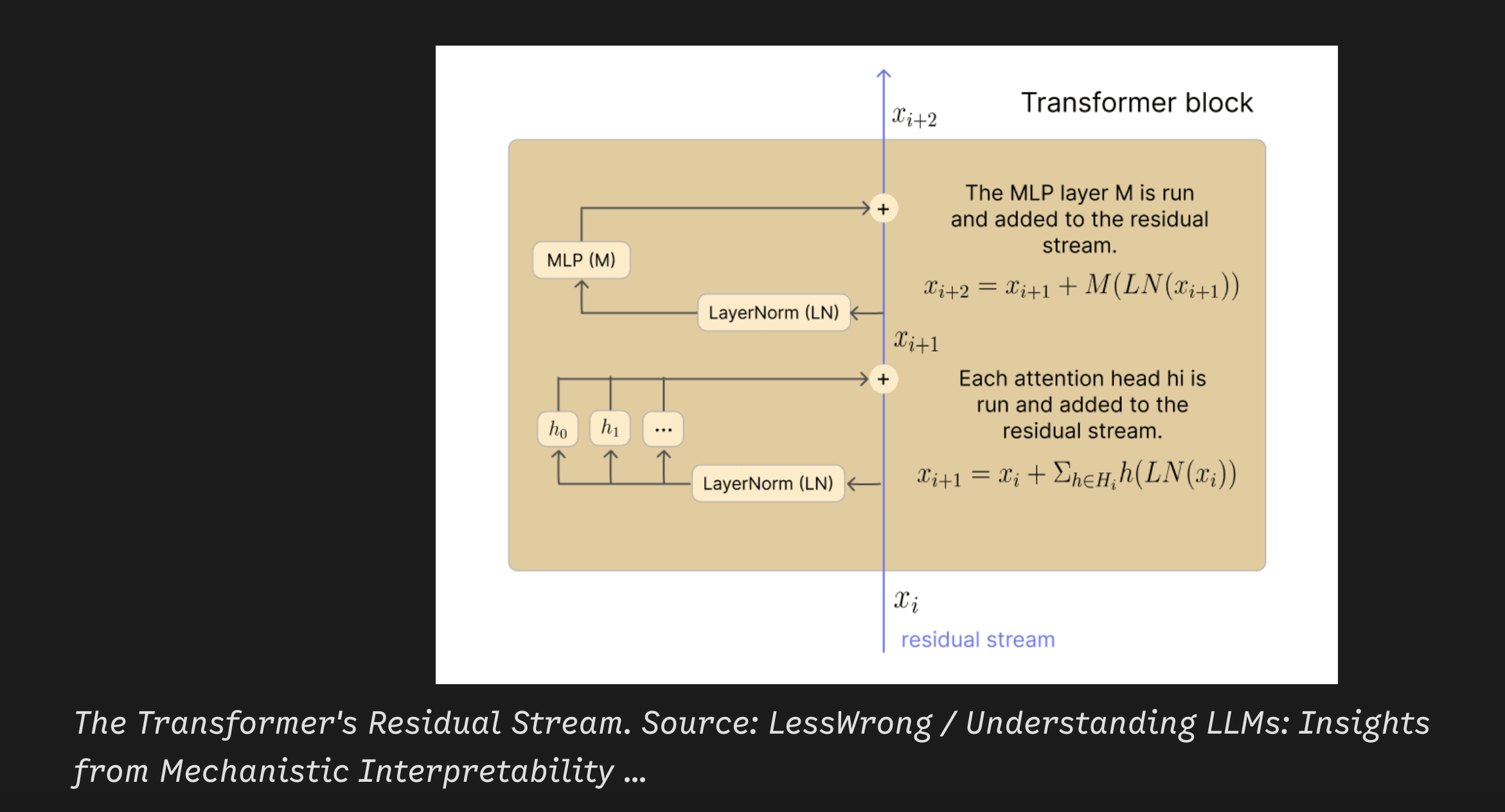
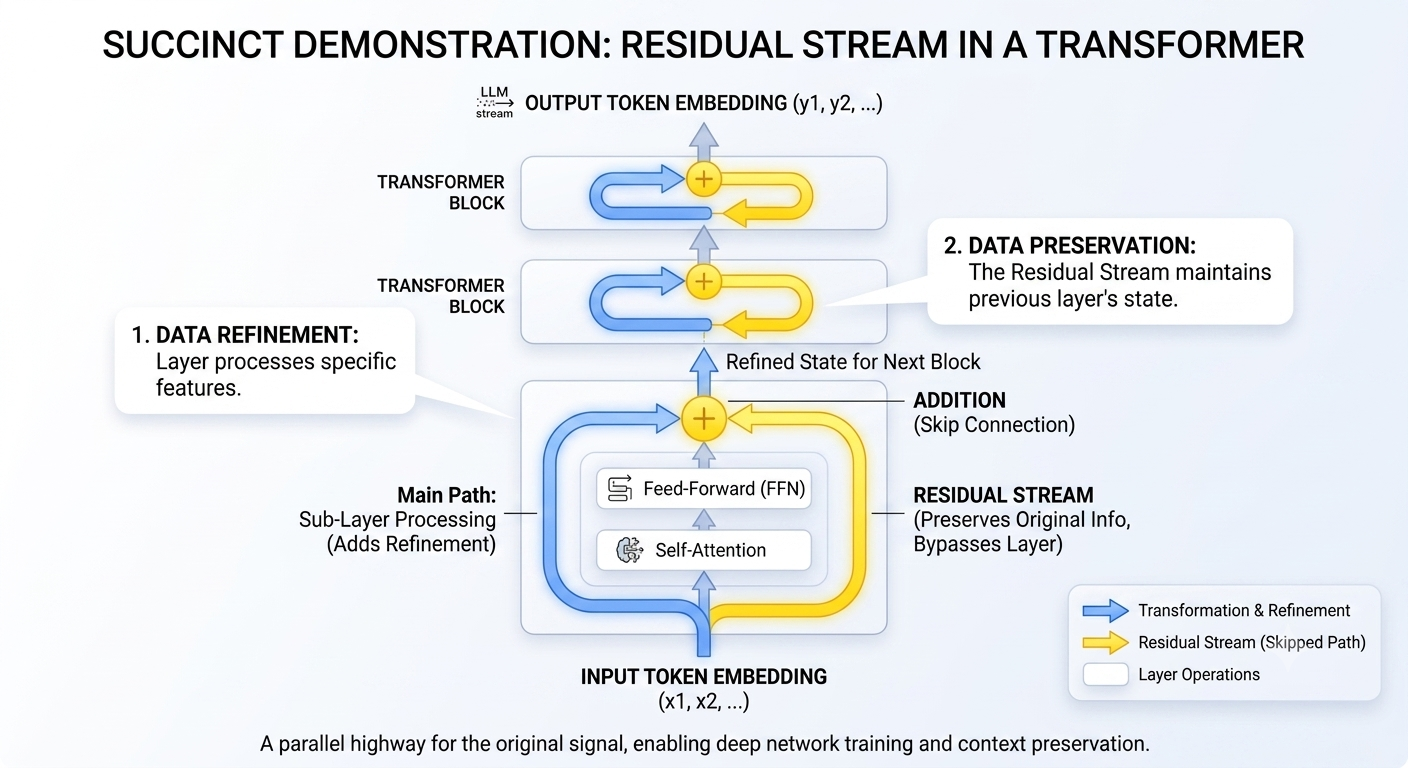
- 💡 without residual connections, the information flow would be bottlenecked at each layer, making it difficult for the model to learn long-range dependencies or retain information across deep stacks of layers.
Pre vs. Post norm
- Original transformer paper residual layer (post norm)
- GPT 2, 3, Llama 2 are pre-norm
Why Pre-norm?
- helps with training stability
-
smoother gradient flow
-
⚠️ All modern LLMs push the layer norm outside the residual stream (but before the compuations/multi-head attention)
- Residual layer has the norm
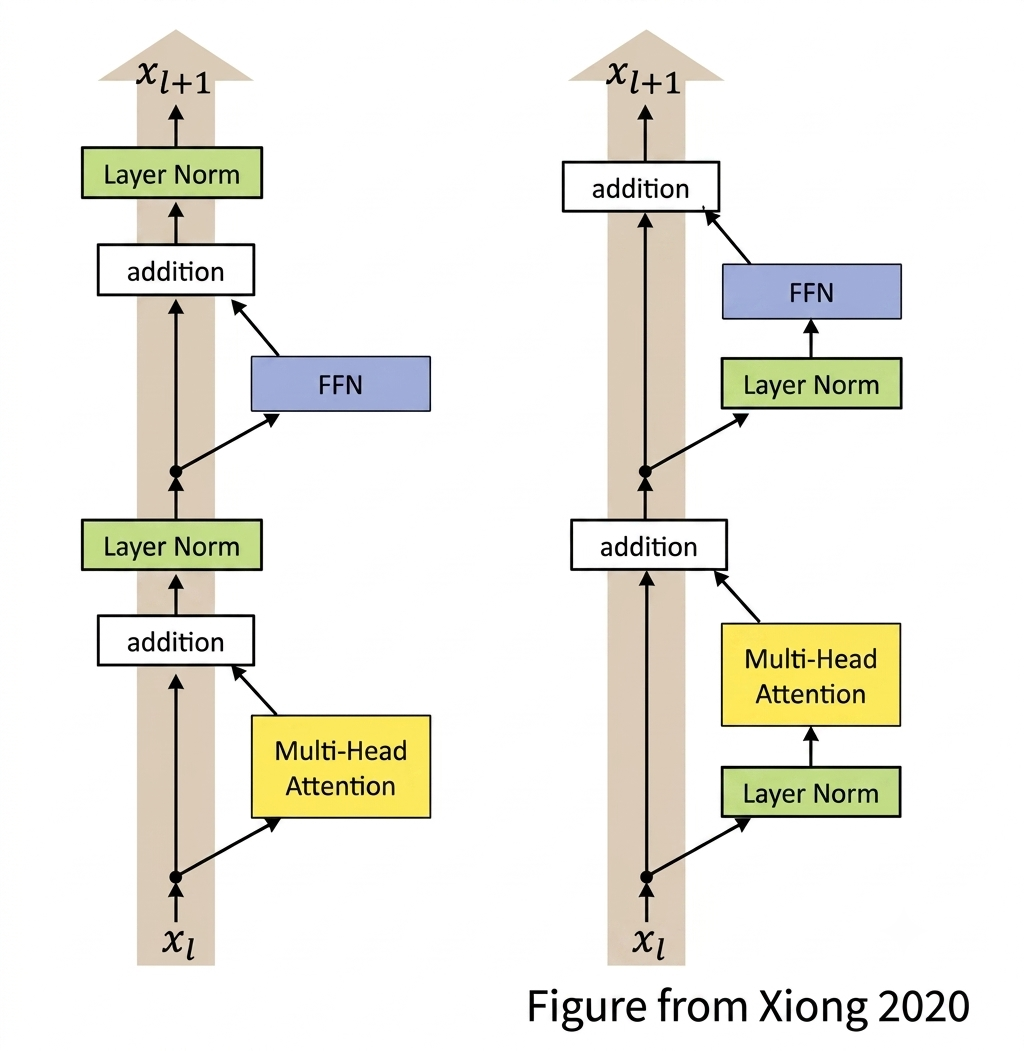
- keep your residual stream clean
-
allow gradients to flow backwards more easily
- 🎥 gradients are stable during training
Double norm
- LayerNorm at the beginning and/or end of Multi-Head Attention (MHA) and Feed Forward Network (FFN) but still outside the residual stream
Why Layer Norm?
-
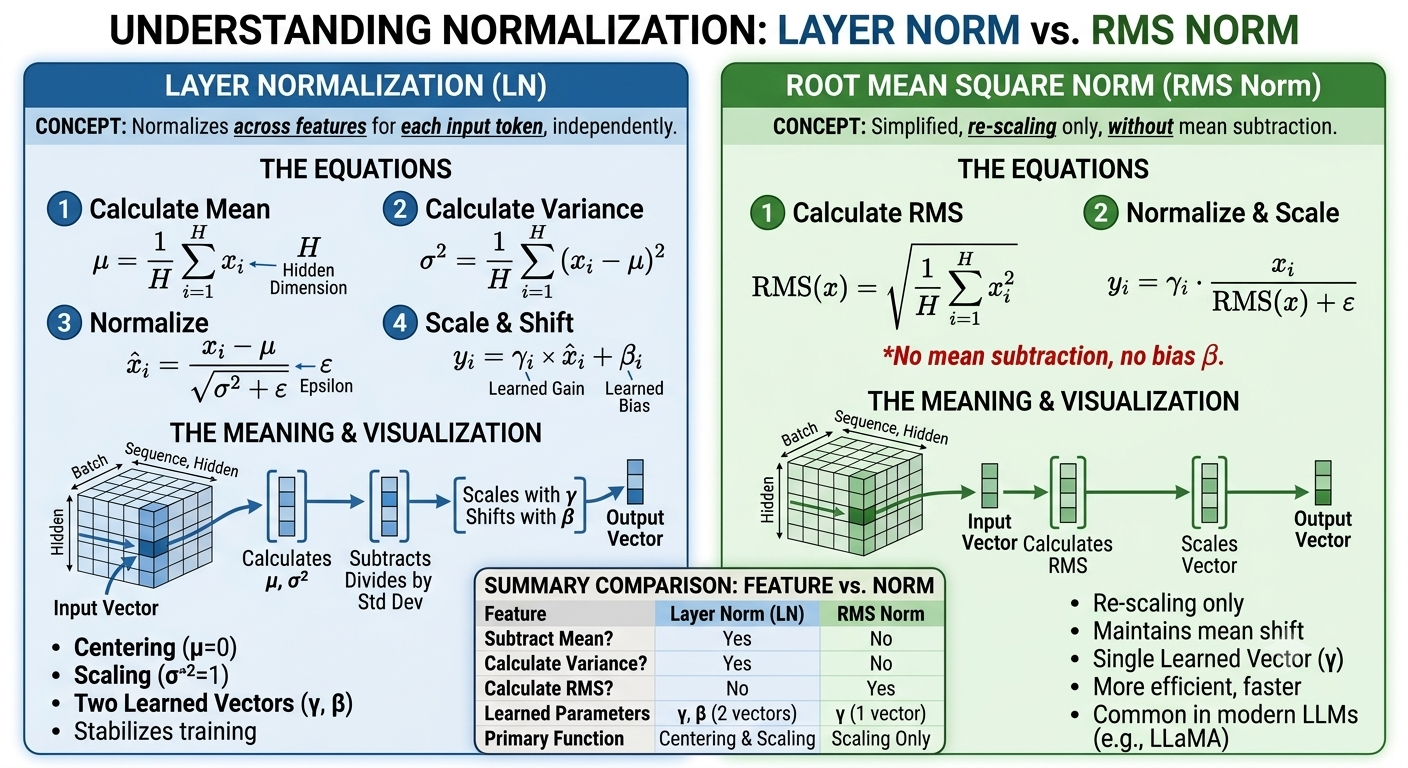
LayerNorm: normalize the input features (per token) across the hidden dimension
-
RMSNorm: does not add a bias term unlike layer norm or subtract mean , it only normalize by the square root of the mean square
-
RMSNorm is faster computationally
-
💡 This is where architecture interacts with system design.
-
Think back to arithmetic intensity and the need to keep the GPUs busy
-
do not move memory back and forth between memory and the compute units
-
inefficient use of GPU
-
FLOPS important but runtime is what matters for inference speed
-
Keep the GPUs fed!
-
RMSNorm can still matter due to data movement
Bias terms
-
Bias terms not helpful for transformers
- Original transformer FFN(x) = max(xW1 + b1, xW2 + b2) + b3
-
Llama 2 FFN(x) = (xW1 + b1, xW2 + b2, xW3 + b3)
-
Most implementations now: FFN(x) = sigma(xW1)W2
-
reasons: memory, efficiency, training stability
-
get the easy systems win!
-
drop bias terms: keep the system more arithematically intense
- you do lots of experiments: no way to know what will work beforehand
Zoo of activations
- ReLU: FF(x) = max(0, xW1) W2 used in
Chinchilla -
GeLU: Gaussian noise around 0 (used in
GPT-2) -
Gated ReLU (reGLU): gating is very effective
-
SwiGLU: swish is x * sigmoid(x)
- 💡 GLUs (gated) are better at loss (not much loss in computational cost)
Serial vs Parallel
-
normal transformer blocks are serial: they compute attention and then FFN/MLP
-
serial still preferred (depth loss deleterious)
Position embeddings
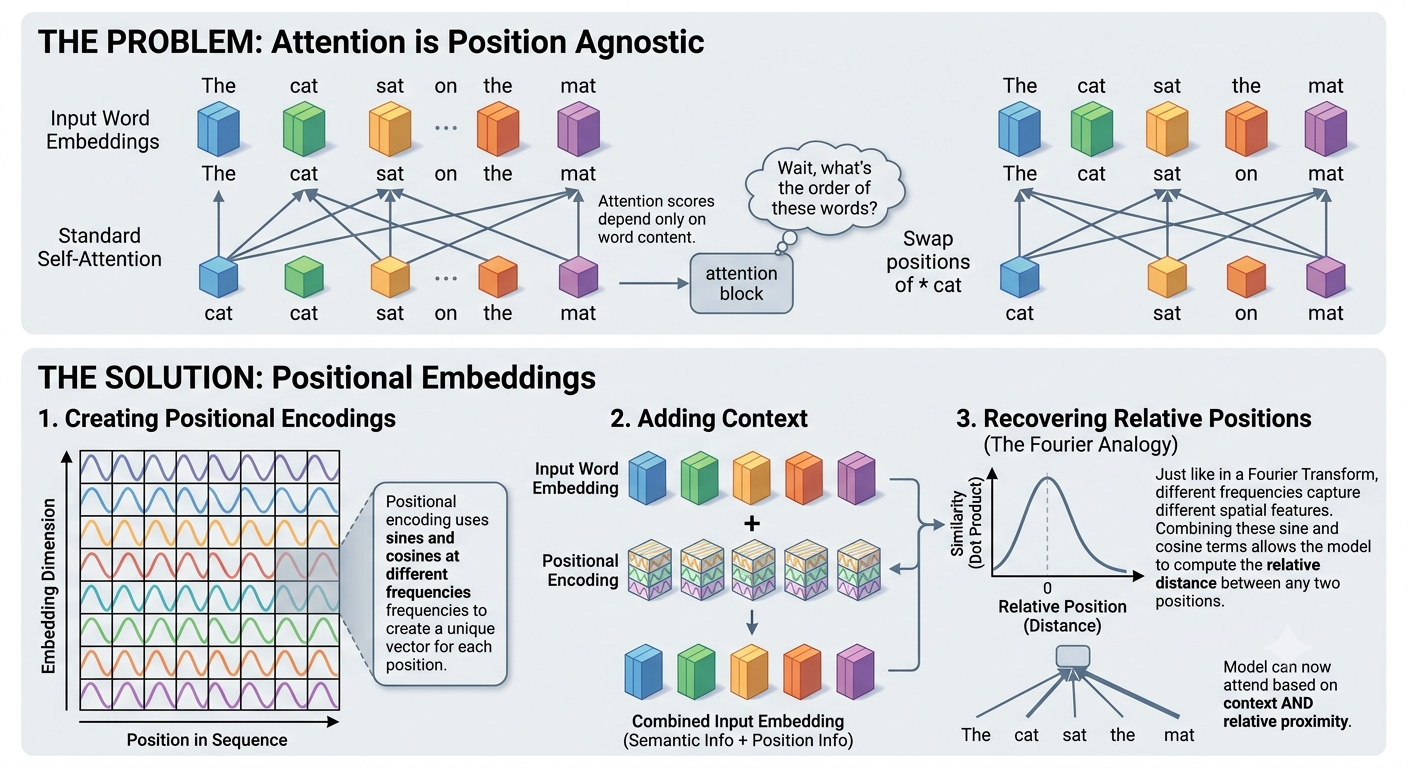
- attention is position agnostic
-
so need a way to represent position
- Concept 🧩 🚀 if you have
sinesandcosinesthen you can recover relative positions (similar to a Fourier transform)
-
Absolute embeddings :
-
Relative embeddings : add a vector to the attention mechanism
-
Rope embeddings: RoPE (Rotary Position Embedding) :
-
inner products are invariant to arbitrary rotations
-
we want embeddings to be position dependent
-
RoPE intuition : Concept 🧩 🚀
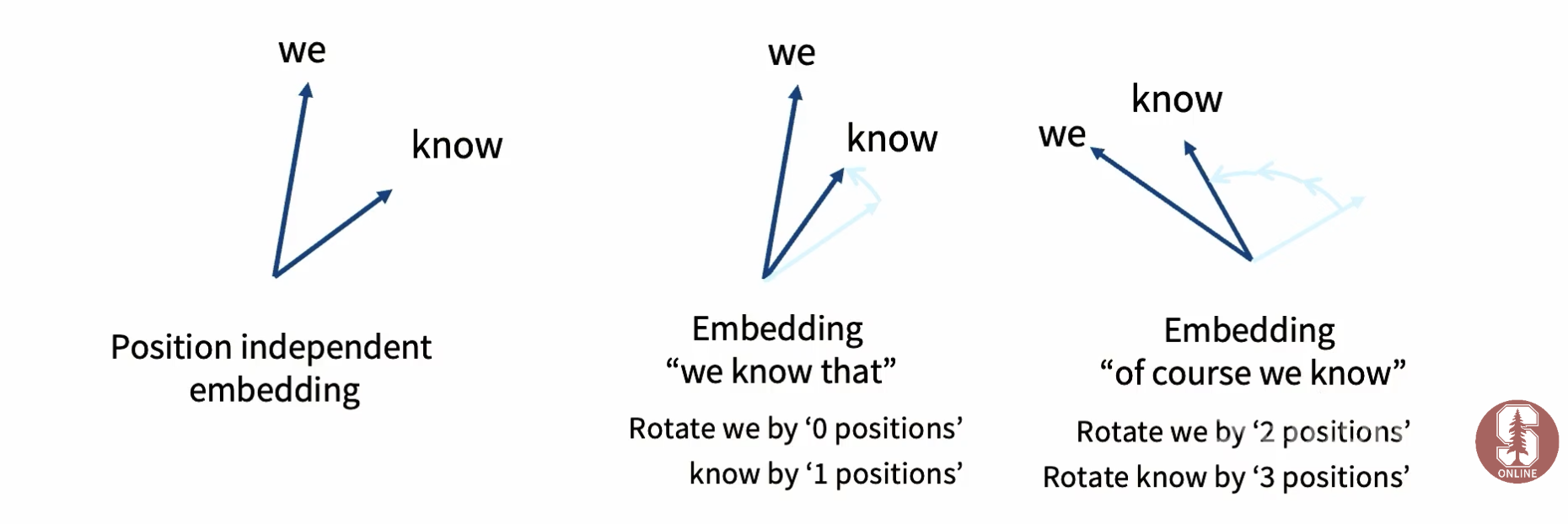
Image from 🎥 Stanford CS336 course
-
now you can take inner products
-
what do you in d dimensions? How do you rotate in higher dimensions?
-
low frequency parts (f1) change slowly, high frequency parts (f2) change quickly
-
📝 Image from Paper on ROPE
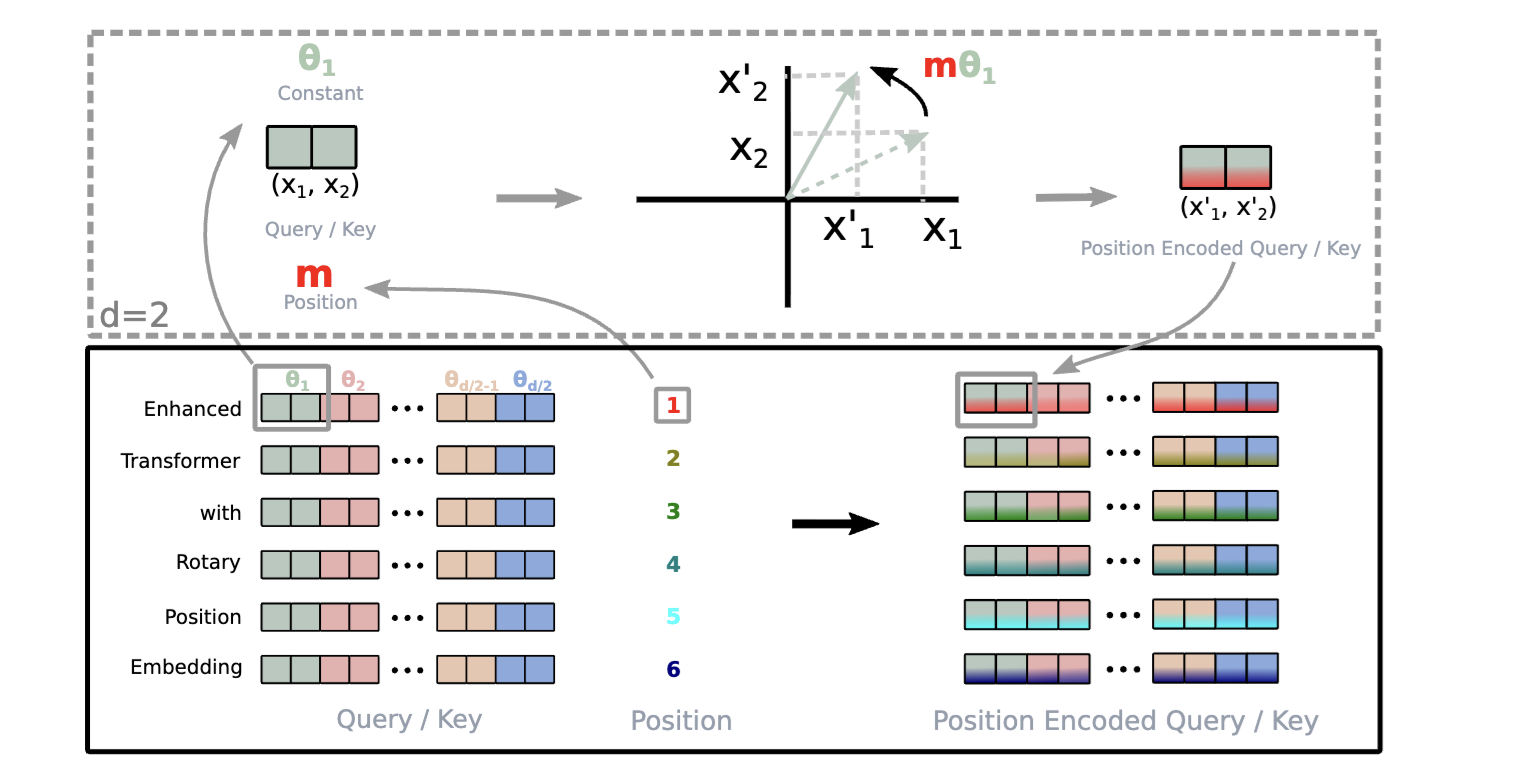
- Gemma has proportional rotary position embeddings (PROPE): just rotate first two
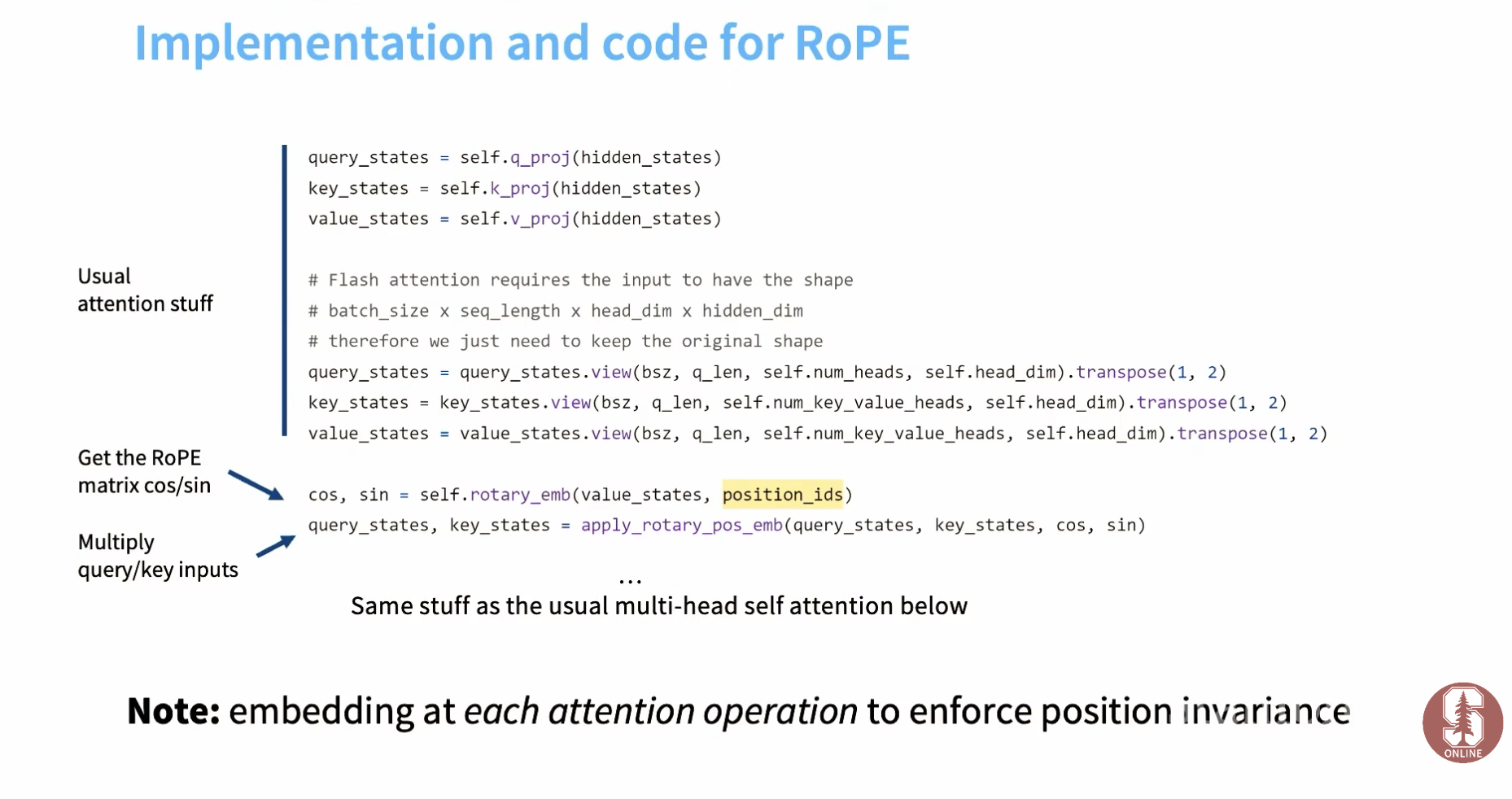
🎮 Practical: implementation and code for ROPE
Consensus hyperparameters
dff = 4 * d_model- dff (feedforward dimension)
- d_model (model dimension)
-
richness of your MLP (multi layer perceptron)
-
Exceptions: GLU variants
T5: 64 multiplier to keep GPU busy
Consensus hyperparameter 2
-
Multi head attention
Aspect ratio
-
aspect ratio: deep vs. shallow
-
aspect ratio = d_model / n_layer -
approx. 100 for most models
-
100 deep for every layer
-
deep models are hard to parallelize (Tay et al 2021)
-
expressivenessreasons to go deep -
systemsreasons to go wide
Vocabulary size
- Original Transformer (37k tokens)
-
Larger vocabulary -> larger embedding matrix
- multi-modal models (images and text): use larger vocabulary with its own image tokenizer and image vocab
Dropout and regularization
- dropout
- weight decay
- weight decay interacts with learning rates (cosine schedule)
- regularization affects optimization
- allows you to use learn faster
- TODO: add practical for this
Stability tricks
- no spikes in loss during training
- softmax can be ill-behaved (due to exponent and divide by zero)
z-losspenalizes large logits- adds a regularizing term to the loss function
- penalizes large values and how far from 0 it is
- Devlin 2014
- useful for stable training
- used in
PaLM
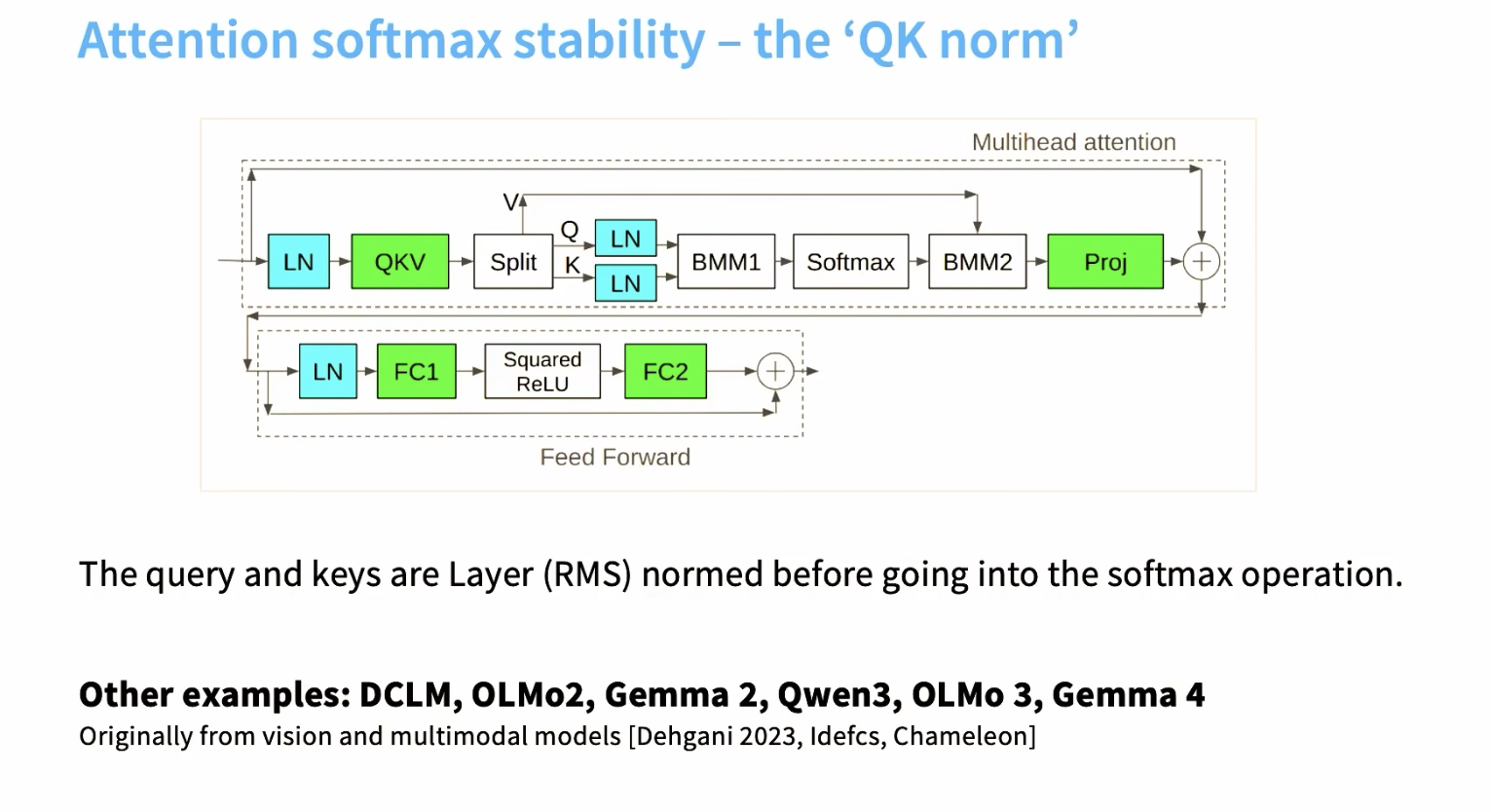
Attention softmax stability
QK norm- if you have instabilities, throw a layer norm in there
- query and key values are layer (RMS) normed
- then inputs to softmax are better behaved
🎮 Practical
QK-norm
-
QK-norm addresses attention logits. But there’s a second place large logits show up: the final output head, right before the softmax that turns logits into next-token probabilities
-
this is addressed by
z-loss -
Here’s the subtle problem: softmax (and therefore cross-entropy) is shift-invariant, exactly as we proved in section 2. That means cross-entropy loss has no preference at all over the overall scale of the logits - it only cares about the differences between them. If the training data is close to linearly separable, gradient descent will happily keep pushing every logit larger and larger forever (larger logits -> more confident softmax -> lower loss), even though the predictions stop meaningfully improving. Nothing in the loss function says “stop growing.”
-
z-loss adds a small penalty term that directly targets this: it penalizes $\log Z$ (the log of the softmax normalizer, also called the log-partition function) for straying away from zero:
- Since $\log Z$ moves in lock-step with the overall logit scale but does not depend on which class is correct, this penalty restrains logit growth without fighting cross-entropy’s job of telling right answers from wrong ones.
😂 Lesson?
-
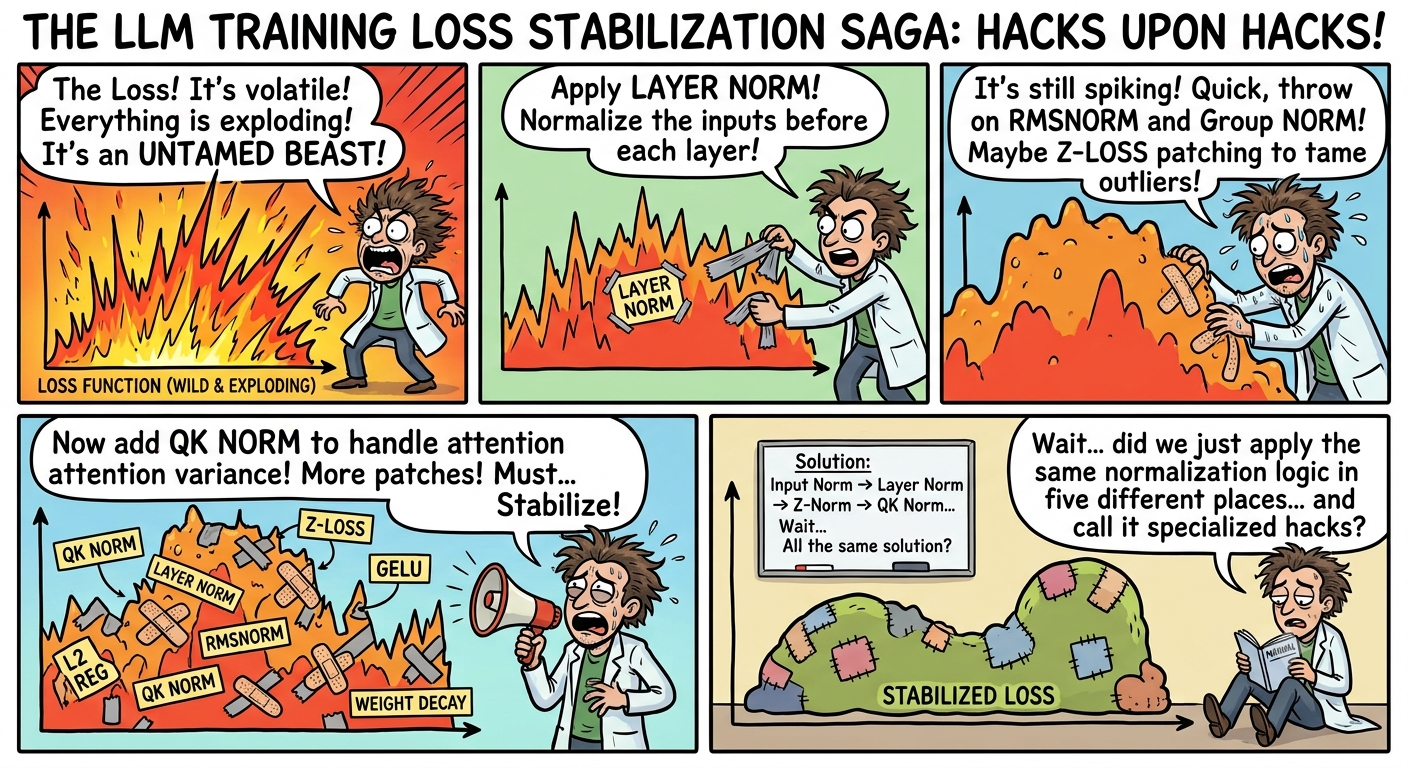
🎉 🥳Here is a funny comic that summarizes the situation
-
Imagine you’re trying to bake a soufflé, but every time you put it in the oven, it violently explodes.
-
To fix it, you attach a metal clamp to the dish. Then you add a rubber band around the middle. Then you wrap the top in foil.
-
After months of research, you step back and realize: you didn’t invent three revolutionary baking techniques. You just put duct tape on the same problem in three slightly different spots.
-
That’s modern Large Language Model (LLM) training in a nutshell. When AI models learn, their internal numbers often swing wildly out of control (“loss spikes”).
-
To stop the AI from losing its mind, researchers invent complex-sounding hacks like LayerNorm, QK Norm, and Z-loss.
-
The dirty secret? They’re all essentially the exact same mathematical trick—normalizing numbers so they don’t blow up—just slapped onto different parts of the network.
-
Concept 🧩 🚀 AI engineering in a nutshell:
- 50% deep mathematical rigor.
- 50% wrapping duct tape around existing duct tape until the loss curve stops looking like a crime scene.
Logit soft-capping
-
logits = softcap * tanh(logits / softcap) -
Gemmauses this
Attention heads
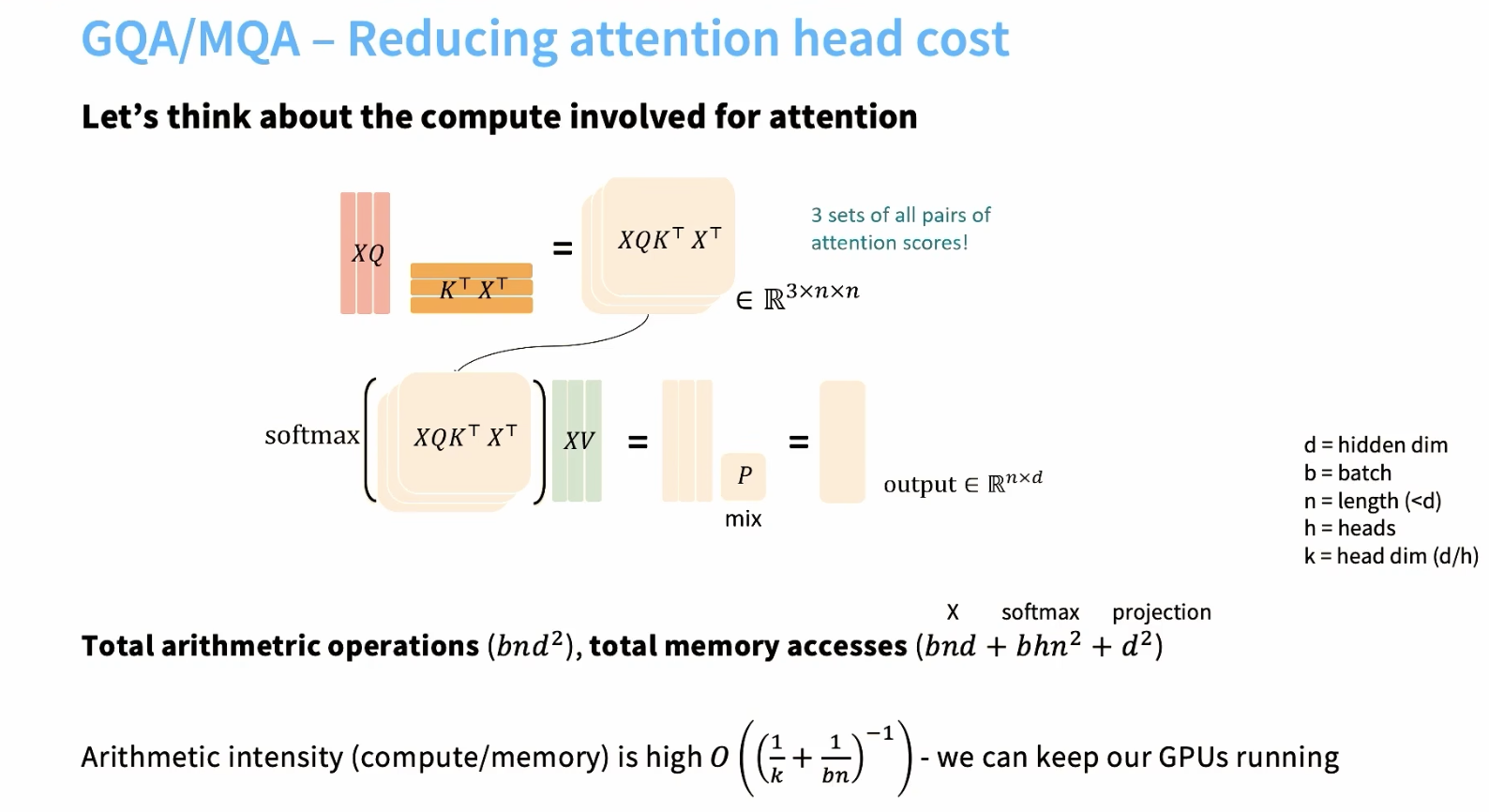
- GQA/MQA: reduce number of heads
- see lecture on different kinds of attention
- sparse or sliding window attention: GPT-4, Mistral
Reading VERY GOOD
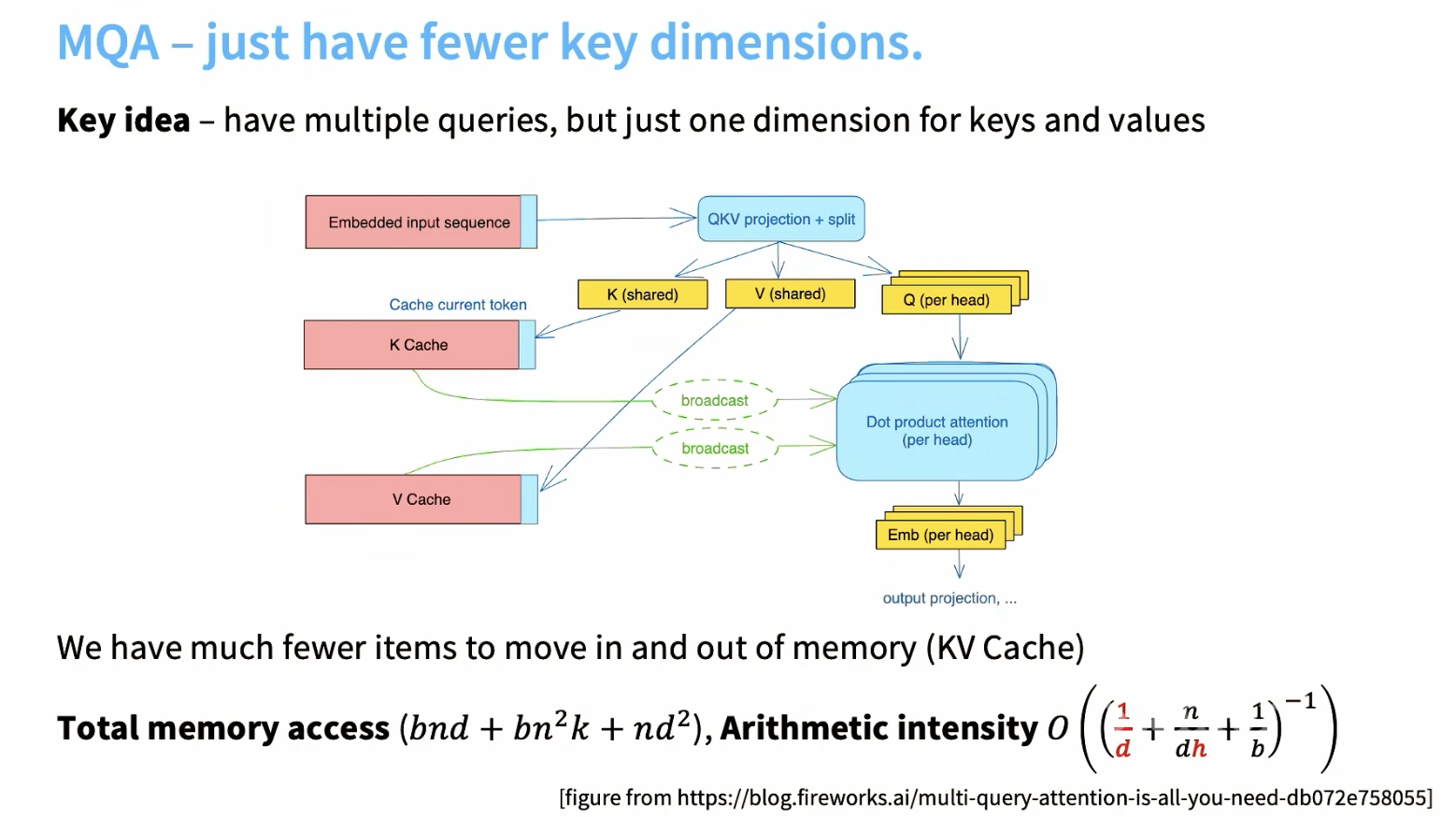
Multi-Query-Attention (MQA)
-
fewer items to move in and out of memory
-
KV Cache reused across heads
GQA
Multi-Head Attention (MHA)
TODO Practical based on how this affects performance
- Does MQA hurt?
Sliding window attention
-
interleave full and sliding window attention
-
Cohere command A: every 4th layer is full attention -
Concept 🧩 🚀 tradeoff between long context attention and performance
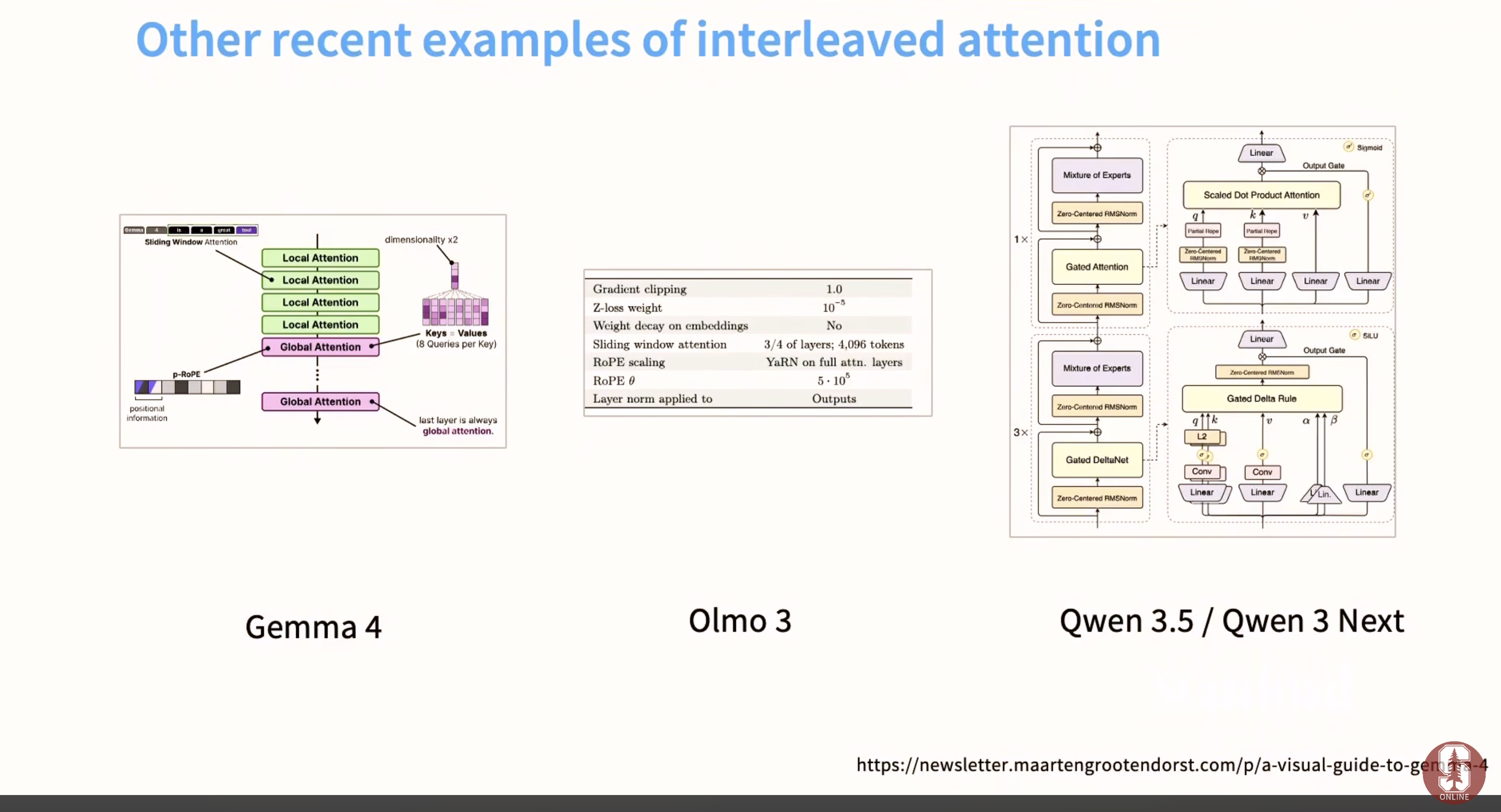
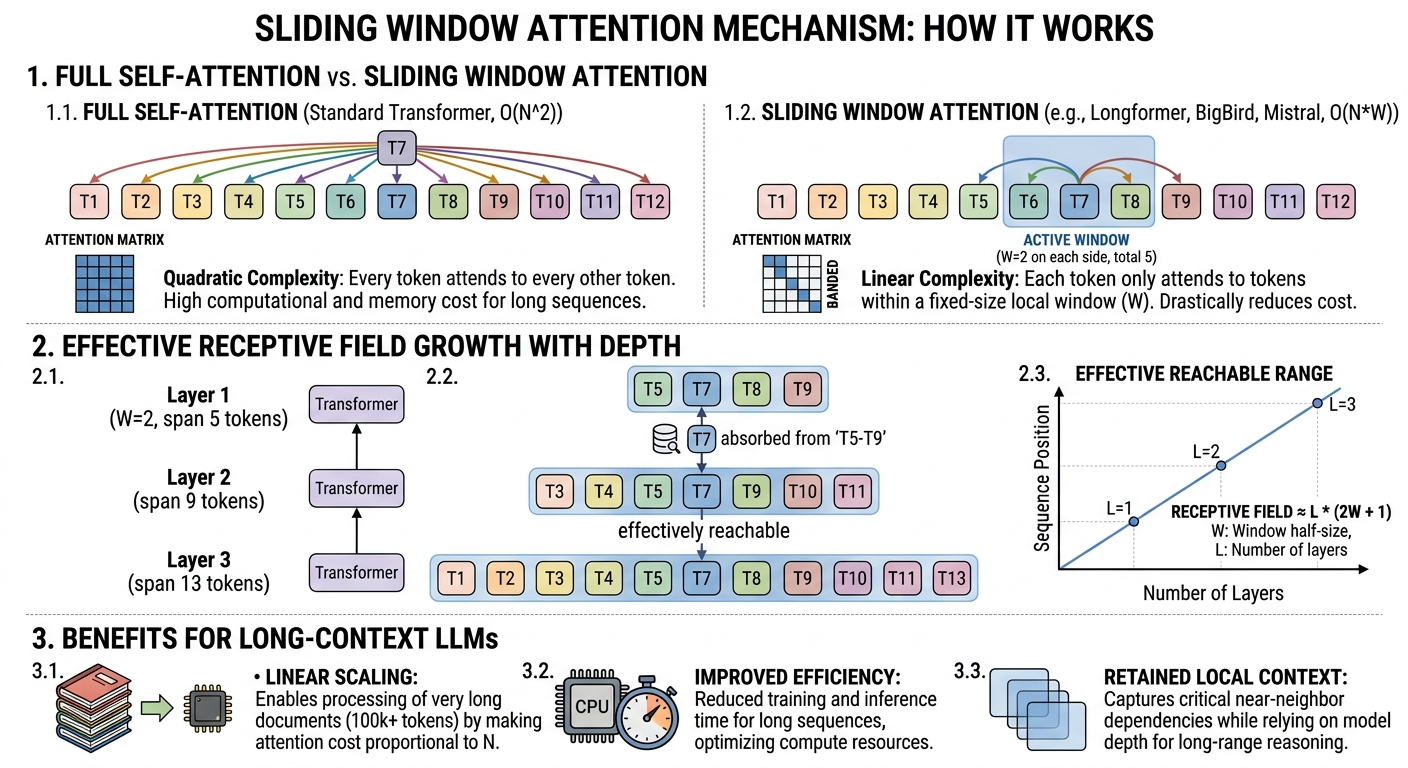
- hybrid: between full attention and cheap attention